
I Told Investors, Publishers (and Pretty Much Everyone Else) That This Game Would Print Money
Dead as Disco’s zero-budget playbook, the Next Fest studios that took it further, and the three questions every indie founder needs to answer before launch day.

TL;DR
2026 is the most crowded entertainment calendar in history: GTA VI, Avengers Doomsday, new Game of Thrones, Toy Story 5. For indie studios, the question isn’t how to find a better launch window. It’s whether you built something that doesn’t need one.
Dead as Disco rewrote the marketing playbook: 1.2 million demo players and 300 million video views generated by players, not campaigns. Brain Jar designed a mechanic that made every player a marketer.
The Steam Next Fest February 2026 winners understood the principle and scaled it. Every genuine breakout entered with community already moving: Windrose had 40,000 Discord members before the fest opened, Burglin’ Gnomes peaked before the window even started.
What changed isn’t the marketing. It’s where the marketing lives: It’s in the game.
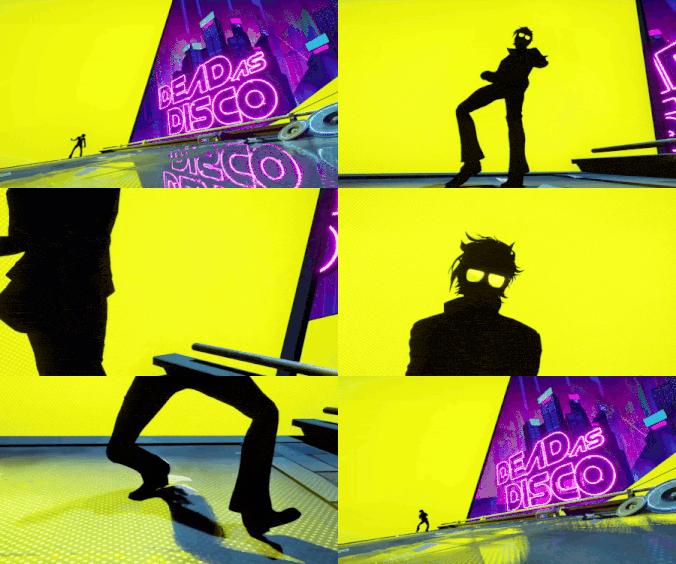
I met Will Cook, Brain Jar’s CEO, in May 2025. Dead as Disco was being whispered about in certain circles at the time: the kind of quiet, conference-corridor conversation where someone leans in and says you need to see this. Will got me access to the community demo, and I played it.
I came away from that session and told more than one investor and a publisher or two or three or four that this game would print money.
At the time that felt like enthusiasm. Looking back, it was just pattern recognition. The wishlist numbers and Discord activity I was seeing even then told you everything about what was coming. Not because Dead as Disco had a great marketing campaign. Because Brain Jar Games had built something that made marketing almost beside the point.
By April 2026, the game had 1.2 million demo players, 300 million views across social platforms, 750,000+ Steam wishlists before Early Access had even opened, and a 98% Overwhelmingly Positive rating on Steam.
Do you remember your mom telling you about their friend’s kid becoming a doctor. Dead as Disco (or Will) was that kid.
Brain Jar had closed an oversubscribed $6.7M seed round co-led by Transcend and Menlo Ventures. All of this was built on the back of zero publisher support and a community that a studio-produced marketing campaign could never have manufactured. Early Access is set to launch May 5 (2026).
The investors I spoke to last year know exactly what I was seeing. The publisher conversations have a different shape now.
This is the piece I’ve been waiting to write since that demo session: what Brain Jar actually built, how the winners of Steam Next Fest February 2026 took the same principle further. The studios that are going to survive the most crowded entertainment year in history already understood it before 2026 started.
The Year That Broke Calendar Dependency
2026 was always going to be difficult. It’s been historically difficult.
Pandemic-era productions colliding with boom-cycle greenlights built on 2020-era assumptions.
The result is a 12-month window carrying the weight of three years of backed-up product. New Game of Thrones, Euphoria, Toy Story 5, Avengers Doomsday, and GTA VI all in the same calendar year.
Publishers renegotiating platform deals and rewriting marketing budgets in real time as Rockstar’s date settled into place.
For AAA and AA studios, the calendar reshuffle became an existential calculation. Move to March 2027 and absorb the runway cost. Stay in Q3 2026 and compete with GTA VI for the same audience attention.
One publisher I spoke with described recalculating $400 million worth of Q4 2026 releases. Another founder told me, at 2am on a call, that they had three weeks to decide before their platform deals locked.
For indie studios, the math looked different. Not better: different. The traditional levers were already failing before 2026 made everything worse.
Steam Next Fest February 2026 had 3,500 demos, a 51% increase on the year before. The median game earned roughly 200 wishlists and 11 Steam followers for seven days of work.
One developer shared a direct comparison: same game, same starting position, two different years. February 2023: 900,000 Steam impressions, 1,600 wishlists. February 2026: 58,000 impressions, 350 wishlists. A 15x reduction in organic reach. Not a bad game. Not a bad campaign. A structural shift.
The press release was already dead. The Next Fest was already a harvest, not a launch. And now the entertainment calendar had a gravitational center pulling everything else into its orbit.
The studios that navigate 2026 weren’t the ones who found clever windows. They were the ones who had been building for a year before any of this was visible.
What Brain Jar Actually Did
Dead as Disco didn’t just go viral. It was designed to.
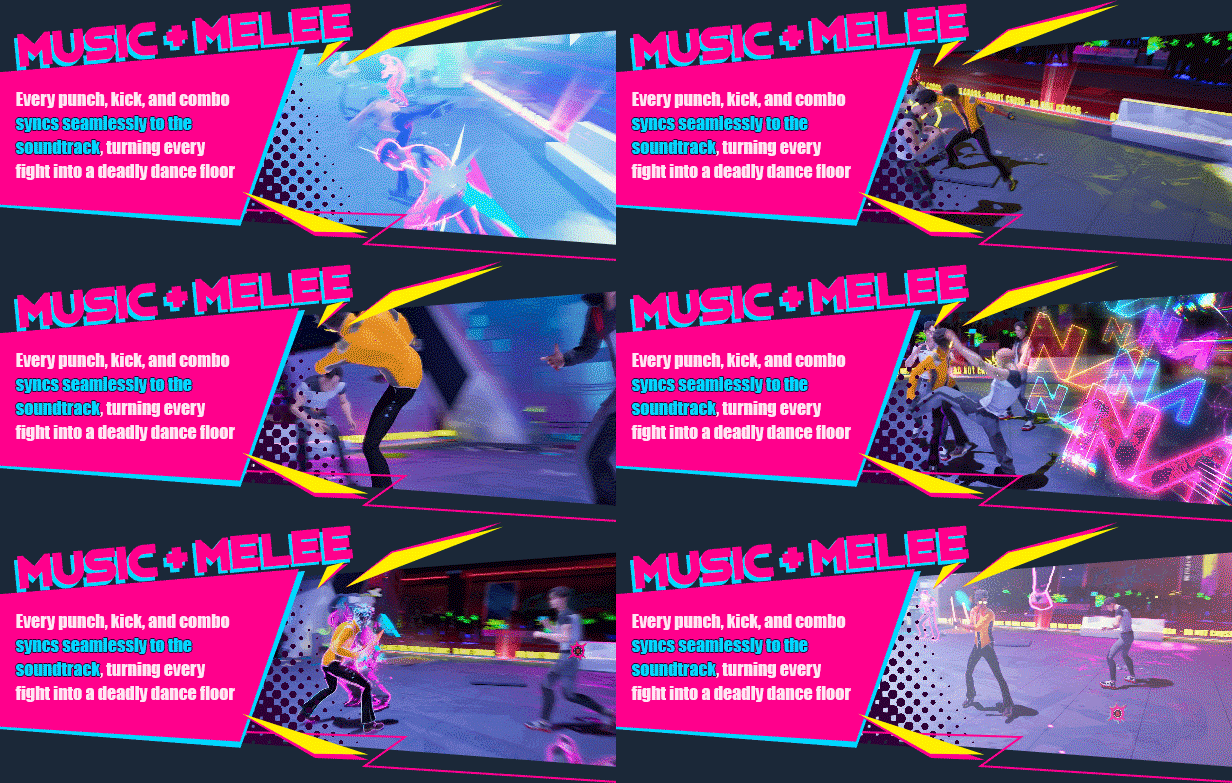
The game is “martial arts meets music video”: a rhythm brawler where every punch and combo syncs to the beat of whatever music is playing. The critical mechanic is called Songcrafter, a system that lets any player import any song and have the game generate beat-synced combat around it.
87% of players who tried the demo imported their own music. A precise measure of how the game was designed to create something no studio marketing team could manufacture: a shareable moment that belongs entirely to the player who made it.
Most rhythm games filter players by skill: if you can’t hit the beat, you look incompetent on video. Brain Jar built a beat-warping system that ensures every attack responds the moment you press, but doesn’t connect until the proper beat arrives. You feel cool regardless of your timing. Even a casual player produces a clip that looks like they know what they’re doing. It’s why an account with 800 followers could post a session and watch it reach two million plays.
In January 2025, Brain Jar posted raw, unedited footage on TikTok and YouTube. No campaign. No influencer seeding. Just gameplay. Three million views in the first month, driven almost entirely by one question in the comments: can I fight to my music?
The answer came through a playtesting sequence I’ve thought about in every founder conversation since. Brain Jar invited 200 Discord members to test Songcrafter under NDA. Net Promoter Score: +93.5. For context, most games don’t crack 50.
The demand was so intense the studio made a call that almost never happens in practice: they dropped the NDA entirely and invited 3,000 more players the following weekend.
Within 48 hours, the first viral clip appeared. Two million plays from an account with fewer than 1,000 followers.
Most of the reach didn’t come from the official account. It came from ordinary players who found the right song combination and watched their clip detonate on a For You page that doesn’t care about follower counts. TikTok drove over 50% of the game’s wishlist traffic, more than any other channel.
The thing to understand is not the scale of the result. It’s how early the work started. January 2025. Sixteen months before Early Access.
The Principle Under the Mechanic
I want to be precise about what Brain Jar actually discovered, because the wrong lesson from Dead as Disco is “put your game on TikTok.” The right lesson is more uncomfortable.
The line between game design and game marketing has dissolved. Not weakened. Dissolved.
Studios that “do TikTok” by posting trailers and feature announcements are doing push marketing: broadcasting messages at an audience that may receive them or may not.
Studios whose games generate player-created content as a natural byproduct of being played are doing something structurally different.
The audience is pulling content toward itself: because watching someone fight to their favorite song is more compelling than anything the studio could script about its own game.
The studios that understand it design shareability into the game before they design the marketing campaign.
The studios that don’t treat marketing as something that happens after the game is finished; then wonder why their polished trailer doesn’t move the numbers the way an unedited clip from a player with 800 followers does.
Songcrafter is not a marketing gimmick Brain Jar added to generate clips. It is a core design mechanic that happens to produce the most powerful marketing asset the studio could ever have.
The distinction matters because it determines when the decisions get made. If shareability is a feature you add for launch, you are already twelve months late.
How the Next Fest Winners Took It Further
Dead as Disco proved the principle in 2025. The genuine breakouts of Steam Next Fest February 2026 scaled it, each through a different route.
Windrose, a pirate-themed survival crafting game from a roughly 60-person team in Uzbekistan, is the most complete execution of the template in the entire 2026 data set.
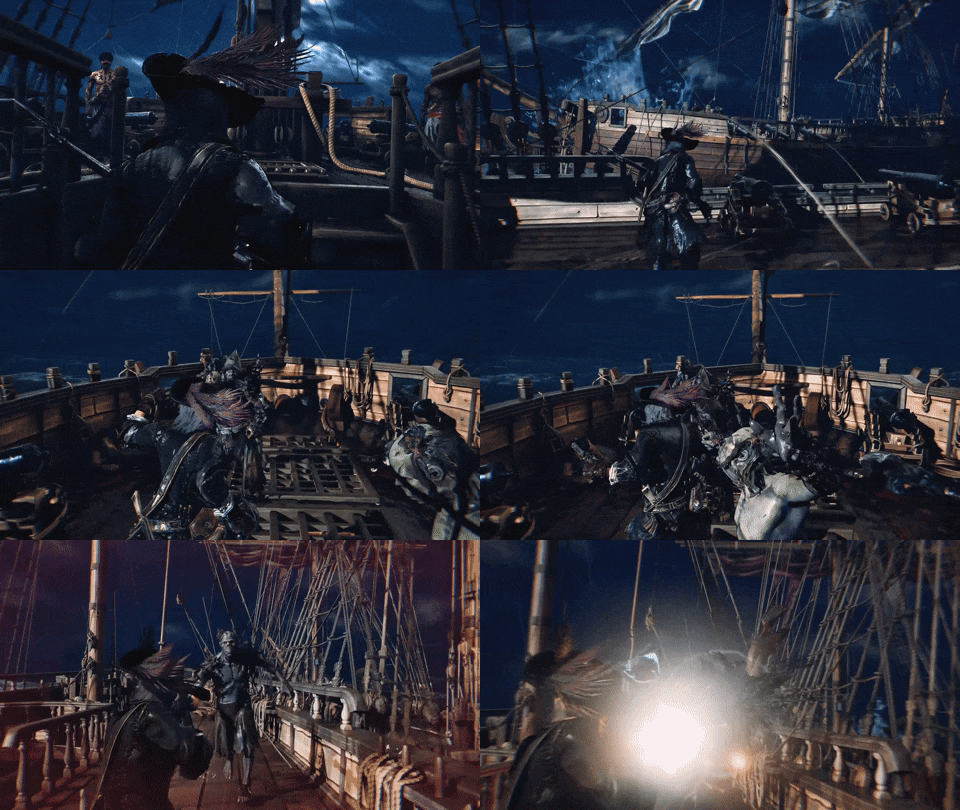
Kraken Express, began seeding micro-influencers in July 2025: not mega-channels with mass audiences, but niche survival and MMO content specialists: GameEdged, Waydot, Kage848. The choice of creators wasn’t strategic in the broad sense. It was surgical.
Alinea Analytics data on the Windrose player base shows that 60% had previously played Valheim, 50% ARK: Survival Evolved, 40% Sea of Thieves. Kraken Express didn’t build a community of gamers. They built a community of survival genre superfans, and they seeded it through the exact creators those superfans already trusted.
Every creator who played the alpha loved it. That reception compounded into press attention the studio couldn’t have purchased. By the time the February fest opened, Windrose had 40,000 Discord members who didn’t need to be asked to wishlist the game. They were already screaming.
The fest earned 351,000 wishlists. The game sold 500,000 copies in 48 hours of Early Access, reached 1.3 million players in nine days, with a third of those players already logging 20+ hours. Gross revenue in the first ten days: approximately $30 million.
From a team of 60, in Uzbekistan, with no publisher, this was the best survival debut since Palworld. All of it the result of ten months of work that started in July, not in February.
Burglin’ Gnomes took a different route to the same destination.
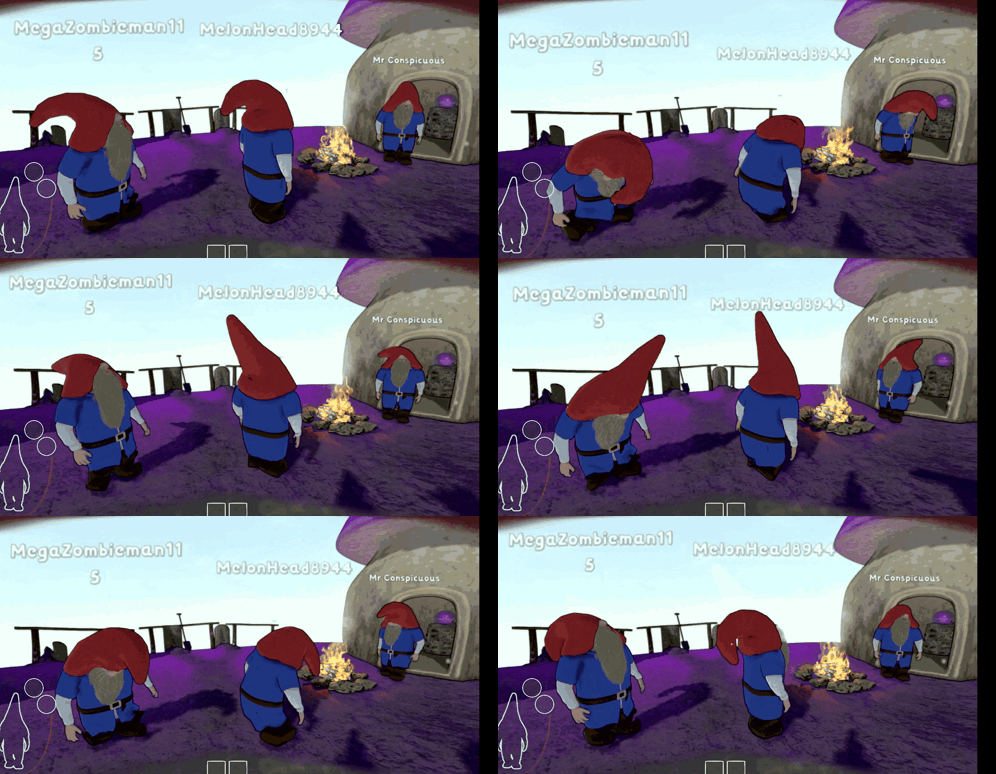
The co-op game about gnomes burgling houses launched its demo before the official fest window opened, creating two marketing beats instead of one. By the time the fest started, the game had already peaked.
Nearly half of its total wishlisters actually played the demo, the highest engagement ratio in the fest by a significant margin.
That ratio is the tell.
When half your wishlisters are returning players rather than algorithmic strangers, you didn’t win the fest. You won months before the fest, and the fest just confirmed it.
Cairn, from The Game Bakers, illustrates the template from a different angle entirely.
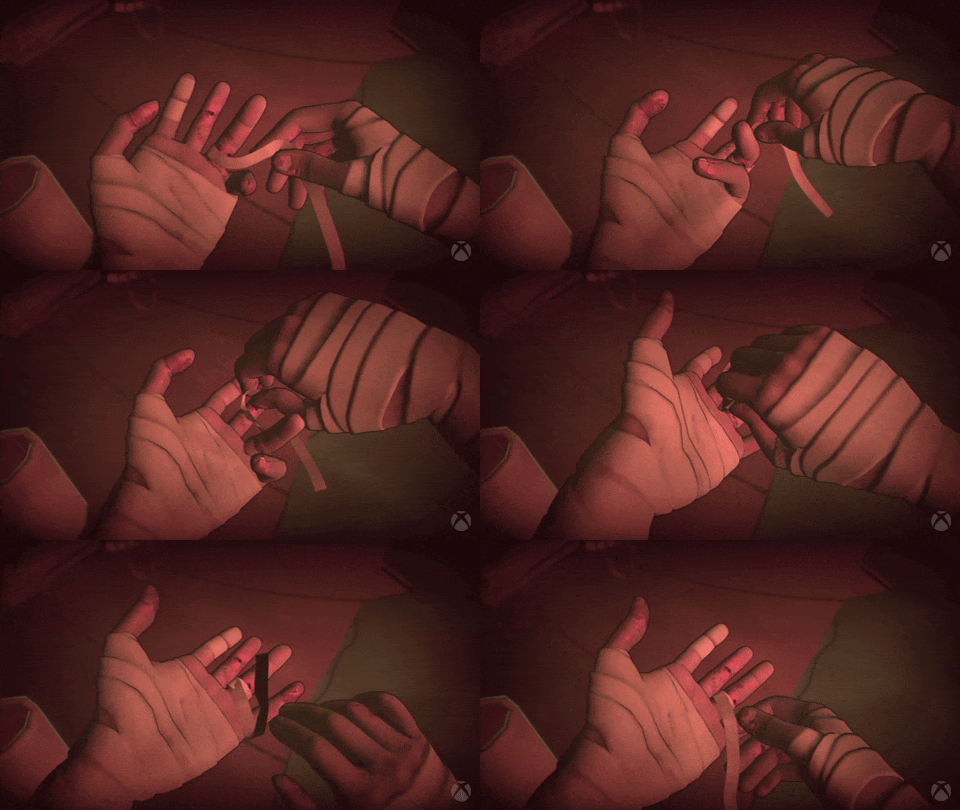
The climbing game was originally scheduled for November 2025, delayed to Q1 2026, and used the gap to deepen community rather than go quiet.
A demo update in October added ghost recordings of speedrunners and other players to the mountain, giving hundreds of thousands of existing demo players something new to share during a window most studios would have treated as dead air.
The delay didn’t break trust. By launch, Cairn had a community that had been consistently engaged through a period that should have worked against it.
Three different mechanics. Three different community strategies. One shared principle: the platform event amplified momentum that was already moving. None of them were discovered at the fest.
What This Means for Studios Building Now
The studios that matter in the next 18 months are already 12 months into their community build. Not their Steam page. Not their press list.
Discord members who’ve played early builds. Micro-influencer relationships built before there was anything to sell. A demo seeded into social channels before any official event window. A creator ecosystem ready to share the moment the mechanic goes public.
The wishlist is a byproduct, not the goal. The studios generating genuine velocity in February 2026 did it through one mechanism: community-driven excitement hitting a natural peak at the right moment. That cannot be manufactured a week before the fest.
The three questions I now run with every studio I advise:
First: if someone finds your game on TikTok today, what do they do next? If the answer is “they go to a Steam page that hasn’t been updated in six months,” the problem isn’t TikTok.
Second: if you disappeared tomorrow, would your community notice? If the answer is no, your wishlist count is measuring noise.
Third: what is the most shareable moment in your game, and did you design it or did it happen accidentally? If the answer is accidentally, you are leaving your most powerful marketing asset to chance.
The founders who can answer all three are the ones I’m least worried about in 2026.
GTA VI, Avengers Doomsday, the franchise pile-up: none of it touches a community built before any of those release dates were confirmed. They’re not competing for attention. They already have it.
The Reframe
Dead as Disco launches into Early Access on May 5, 2026: They’re doing it with 70,000 community members who had been building alongside it since January 2025.
When I told investors and publishers last May that this game would print money, I wasn’t making a bet on the game’s quality. Plenty of excellent games disappear.
I was making a bet on what Brain Jar had already built around it. Those signals were visible in the demo session. They are always visible, if you know where to look.
Brain Jar didn’t find a window in the 2026 calendar. They made the question of windows irrelevant.
The studios watching their Q3 dates with anxiety are solving a real problem with the wrong tools. Calendar dependency cannot be fixed with a better launch window. It can only be fixed upstream, in decisions made twelve to eighteen months before anyone opens a store page.
The question is not “how do we market this game in 2026.”
The question is “what did we build that gives players a reason to market it for us.”
Dead as Disco answered that in January 2025. I saw the beginning of that answer in a community demo last May. The ones that weren’t paying attention are still looking for a window.
Abbas Saleem Khan is a Principal Consultant at Llama & Griffin, advising game studios, streaming platforms, and investment funds across six continents. He writes The Pattern Recognition: gaming industry intelligence 12 to 24 months before it becomes consensus.
Community wins again. Alas, most studios still think community = a Discord + devlogs + hope. But community, like all marketing, starts with the game itself. The game is the signal, and marketing is the amplifier; Songcrafter just made that more visible and legible than most.
Nice to see so many of my theses validated in your analysis, Abbas.
(Btw, I saw Dead as Disco at the Day of the Devs corner at GDC, there was always someone at the demo station. It looks fun as hell. And I was one of those 1.3M Windrose early adopters; it's about time a good single-player pirate sandbox game showed up!)