
Sega: The Master System of Constant Reinvention?
Sega cancelled an $882 million future in the same year it turned nine birthdays into a business unit. That is not a coincidence. That is the plan.

TL;DR
Sega’s 2026 is wall-to-wall anniversaries by design, not sentiment. Sonic, Puyo Puyo, and Persona run their own campaigns, while Sega Universe revives nine dormant properties.
The same fiscal year, Sega cancelled its future: the $882 million Super Game killed, a ¥5.7 billion ($31.6 million) net loss, a $200 million Rovio write-down, and large-scale M&A suspended.
The 65-year pattern: Sega wins when it retreats or buys distressed, and loses when it pays premiums. Atlus at $140 million became the profit engine. Rovio at $775 million became the write-down.
The forward call: the harvest only works if games are ready to catch the spike, and the M&A freeze lands just as distressed assets get cheap.
This piece started with someone else’s newsletter. I have loved Harrison Polites’ work for a while, and his latest Infinite Lives piece is, on the surface, a business case for a butt slider in Final Fantasy XIV. Its real subject: Square Enix quietly refocusing its most reliable earner on keeping the players it has rather than winning new ones; because the ambitious new bets keep missing.
Halfway through reading it, a note I had made months earlier resurfaced: A single line about Sega’s 2026 anniversary calendar, jotted down and forgotten. Harrison’s piece on one Japanese giant retreating to what it already owns made the note legible. Sega is running the same retreat at far larger scale, and calling it a birthday party.
So I went down the rabbit hole, intending to write the story everyone writes about Sega: the master of reinvention. The research had other plans.
Nine Birthdays, One Programme

Start with what Sega announced this year. The sheer density is the tell.
January brought the Sonic 35th anniversary campaign, a full-year brand push with merchandise, partnerships, and fan experiences. Days later came Puyo Puyo’s 35th, with pop-up stores across three Japanese cities and a convenience-store lottery that bundles both birthdays together. In June, Atlus marked Persona’s 30th by confirming the series has passed 30 million units sold, announcing Persona 6, and dating Persona 4 Revival for February 18, 2027.
Then in April came the structural move.
Sega Universe, launched under the banner “NO OLD, STAY GOLD,” is a formal programme spotlighting nine legacy properties hitting milestones in 2026: Fantasy Zone and OutRun at 40, Streets of Rage and Rent a Hero at 35, Guardian Heroes, NiGHTS into Dreams, Dynamite Deka, and Sakura Wars at 30, and Segagaga at 25.
The stated ambition goes beyond games into film, music, and fashion.
Note what is not on that list. Sonic, Puyo Puyo, and Persona run their campaigns outside Sega Universe entirely. This is not a celebration wrapper around the whole portfolio; it is a purpose-built vehicle for IP that has no active game. Hold onto that distinction.
Most anniversaries are usually marketing garnish; Sega has turned them into an operating model. The question is why now, and the answer is in the fiscal results published three weeks later.
The Same Fiscal Year, Sega Cancelled the Future
The FY2026 numbers, for the year ending March 31, 2026, are the other half of this story, and they are brutal in a specific way.
Net sales rose 13.6% to ¥487.5 billion ($3.09 billion).
But the group posted a net loss of ¥5.7 billion ($31.6 million)
Driven by a roughly $200 million impairment on Rovio and;
A second impairment on Stakelogic: the online casino games company Sega bought in 2024.
Entertainment contents operating income fell from ¥40.8 billion to ¥32.4 billion.
Full game sales dropped 12% to ¥67.2 billion despite Football Manager 26 and Sonic Racing: CrossWorlds shipping in the window.
Buried in a presentation slide titled “Review of the GaaS Strategy” was the bigger decision: the Super Game is dead. Announced in 2021 as a partnership with Microsoft’s Azure, scoped at $882 million in planned investment, pitched as an online AAA global hit.
Cancelled with no additional costs, which is corporate language for “we stopped before we spent the dangerous money.”
More than 100 developers moved from free-to-play back to full-game development on mainstay IP. Sonic Rumble Party, the co-development with Rovio, was named directly as having failed to generate economic value. New free-to-play launches are deprioritized. Large-scale M&A is suspended.
Read the two announcements together and the shape is unmistakable:
In one spring, Sega killed its bet on building new things and formalized a programme for harvesting old ones.
Sixty-Five Years, One Pattern
This is where the retrospectives every other outlet will publish get the story backwards. The received narrative is “constant reinvention,” and I know its pull firsthand, because that is the piece I sat down to write.
Look at the actual ledger of the last 25 years and the pattern is more specific, and more predictive.
Sega’s wins are retreats and distress buys.
The hardware exit of January 31, 2001 was a humiliation that became the foundation of everything since: 25 years as a third-party publisher.
The Sammy merger of 2004 was itself a rescue, with pachinko cash subsidizing the recovery.
Creative Assembly, acquired in 2005 for roughly $30 million, still delivers Total War as a top-four franchise two decades later.
And then there is Atlus, the single most consequential move in modern Sega history, and it happened at a bankruptcy auction. Index Corporation collapsed in 2013 under roughly ¥24.5 billion in debt, drawing a bidding war of roughly 20 companies.
Sega won the assets for approximately ¥14 billion, about $140 million. Thirteen years later, Persona alone has sold more than 30 million units, up from the 27 million milestone reported only last July. Atlus is now one of the group’s highest-margin studios, with Persona 6 announced.
Sega’s losses are premium entries into markets it does not run. Rovio cost $775 million in 2023, bought deliberately as a mobile strategy, complete with a proprietary analytics platform that was supposed to lift Sega’s whole mobile portfolio.
Three years later: the impairment, and annual sales declining every year since the deal closed. Stakelogic, bought in 2024, was impaired within two years.
The Super Game, a premium bet on live-service at scale, never even shipped.
I have watched this pattern across enough studio transactions to say it plainly: the price you pay encodes the assumptions you are making, and premium prices encode the assumption that you understand the market better than the seller does. Sega has never once been right about that.
The Catalogue Readiness Problem
So Sega’s answer to a bad year is the harvest: apply the Sonic film playbook to the whole back catalogue. The playbook is real. The film franchise crossed $1 billion in worldwide box office in January 2025, the third film alone returned a net profit of $123.6 million, the Knuckles series broke Paramount+ streaming records, and a fourth film is on the way in 2027.
But it has an ingredient Sega Universe lacks, and it is the same one that separated Fallout from Castlevania.
The films worked as a business because games were always waiting to catch the audience they generated: new releases, an active catalogue, merchandising pipelines already warm.
Now run the readiness check on the Sega Universe nine, a slate selected precisely because none of its IP has a current game. OutRun’s last mainline entry is decades old. NiGHTS has had nothing since 2007. Sakura Wars’ 2019 revival stalled. Segagaga never left Japan.
If NiGHTS and Sakura Wars transmedia projects land this summer as reported, any audience they generate arrives at a storefront with nothing on the shelf. Sonic earned its flywheel warm; Sega Universe starts cold on every property.
Sega has form here, and the record is mixed.
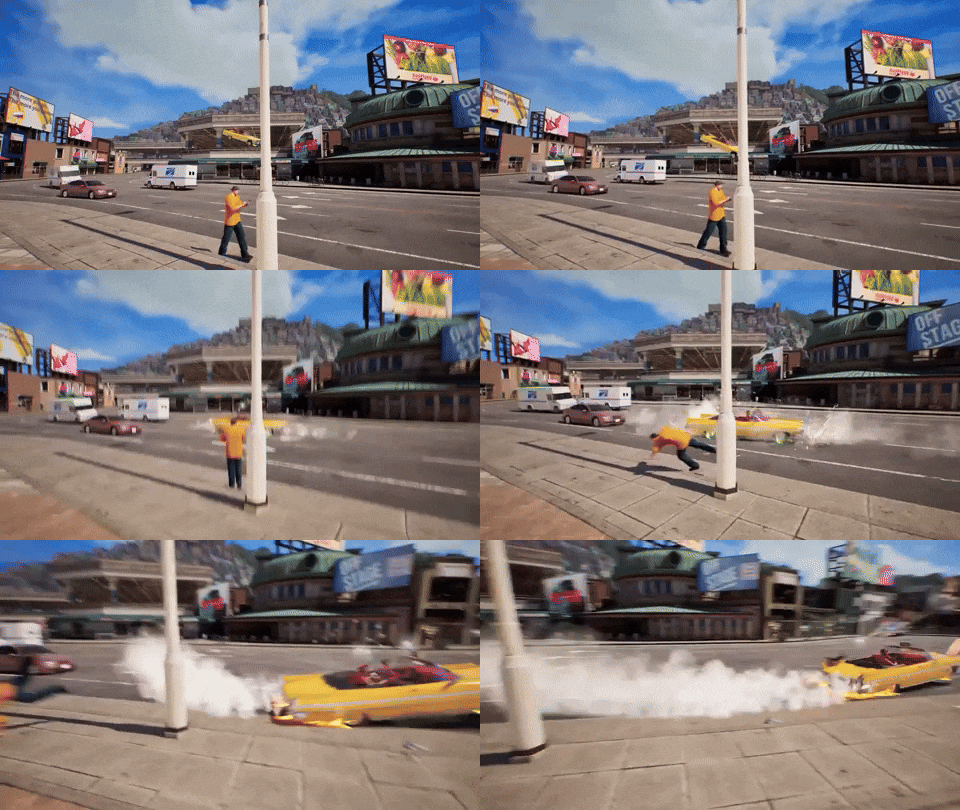
The 2023 revival push promised new Crazy Taxi, Golden Axe, and Jet Set Radio among others; three years on, Shinobi: Art of Vengeance is the only one that has shipped, though the other three still appear as in development on Sega’s own May 2026 roadmap slide. The gap between announcing a revival and shipping receiving products is exactly where the last one slowed to a crawl.
The diagnostic for anyone watching this: do not count the announcements, count the greenlit games attached to them. A Sega Universe project with no playable product inside 18 months of its media beat is merchandise with a press release.
The Freeze Is the Real Story

Here is the take that will split the room. Suspending large-scale M&A right now may be the most expensive disciplined decision Sega makes this decade.
The discipline is understandable: Two impairments in one fiscal year, a Zynga-style redemption arc that Rovio has conspicuously failed to deliver, and a management team that needs to show the market it has stopped writing cheques.
Every instinct in that boardroom says freeze.
But the discipline that stops the next Rovio may also cost them the next Atlus. Look at the timing. My read, and it is a read rather than a sourced fact: the industry is entering a period where distressed studio assets will be more available and cheaper than at any point since Index went under in 2013.
Live-service portfolios are being cut everywhere, funding for mid-sized studios has collapsed, and the shakeout has not finished shaking. These are Atlus conditions. Yet the freeze is stated policy, not rumour.
The fair rebuttal is that Sega has not stopped dealmaking entirely, it has stopped buying:
China and Southeast Asia are the new push, an explicit move to reduce reliance on Japan.
Persona is the spearhead. Persona 5: The Phantom X launched in China through a partnership with Perfect World.
Road to Empress II is the newest pickup, a Chinese-developed hit Sega co-publishes in Japan and parts of Asia without owning it.
Small, cheap bets with real upside, exactly the style Sega wins with. The instinct is old, too: Sega was probing China in 2001, the same year it left hardware.
Sega just took the one tool that has reliably worked for it off the table, at the moment it is about to work best.
Atlus was not a strategy; it was an opportunistic bid. The next one will surface inside two years, and Sega has pre-announced that it will not be in the room.
The Reframe
The coverage this year will tell you Sega survives by constantly reinventing itself.
The ledger says something narrower and more useful: Sega survives by retreating well and buying distressed, and it bleeds whenever it pays a premium to become something it is not.
The 2026 blitz is not nostalgia. It is the company formalizing the only model that has ever worked for it, harvesting owned IP, at the exact moment it is swearing off the acquisition style that built the IP worth harvesting.
Watch two numbers over the next 24 months:
How many Sega Universe properties get a greenlit game attached
How long the M&A freeze survives contact with the first genuinely distressed studio at a 2013 price.
The first tells you whether the harvest is real. The second tells you whether Sega still remembers how it got here.
Abbas Saleem is a Principal Consultant at Llama & Griffin, advising game studios, streaming platforms, and investment funds across six continents. He writes The Pattern Recognition: gaming industry intelligence 12 to 24 months before it becomes consensus. LinkedIn | Schedule a call
Thanks for the high praise here!
I think these companies get a little less scrutiny than usual due to geography. So appreciate any and all deep dives on them!