

TL;DR:
The field: 4,382 tracked demos against roughly 8,682 total entries, up 66 percent on June 2025. The largest edition ever run, against a player attention pool that barely grew.
The floor: the true median game earned somewhere near 200 wishlists, the save-for-later signal that doubles as Steam’s currency of pre-launch demand. Only 788 games entered with more than 2,000 banked, and they are the entire real competition.
The winner: IRON NEST, a two-person team, entered with 250,000+ pre-existing wishlists and added roughly 200,000 more across the festival, the highest developer-verified gain in the event.
The AI quarter: 26.5 percent of tracked demos carried an AI disclosure, up from 21.2 percent in February. Exactly one disclosed title cracked the most-played top 10.
The clock: October runs the 19th to the 26th, with the demo build due September 21 for Press Preview and all items due October 5. The winners of that edition are being decided right now.
Four months ago I wrote that Steam Next Fest is a harvest, not a launch. Next Fest is the free demo festival that Valve, the company behind Steam, runs three times a year, and February 2026 was the evidence then.
June 2026 was the stress test: the largest edition ever run, a demo pool one quarter AI-disclosed, and a field so crowded that the industry data outlet The GameDiscoverCo newsletter described the winners as effectively unsummarizable as one big trend.
The test came back clean. The two most-played demos were a co-op party game from an indie team and a dieselpunk artillery sim built by two people. Both entered with communities that already existed. Neither was discovered.
The Scale Problem Is Now the Whole Problem
June 2026 set the record by every metric.
The GameDiscoverCo newsletter tracked 4,382 eligible demos; the full event carried roughly 8,682 entries.
For context, February 2023 ran on about 900 demos. Three years, more than a fivefold increase in the field, against a player attention envelope that grows only as fast as Steam’s active base does, which is to say slowly.
The compression shows up cleanly in one developer’s own documentation across editions: 1,600 wishlists on 900,000 impressions with a February 2023 demo, then 350 wishlists on 58,000 impressions at a comparable starting position in February 2026.
Roughly twenty times fewer impressions for the same effort. The demo did not get worse. The room got more crowded, and June 2026 made the room bigger again.
The survey math tells the rest. How To Market A Game, the developer survey series that benchmarks these events, put the February 2026 surveyed median at 806 wishlists, the best proxy until the June survey lands.
But surveys self-select for marketing-active developers:
The estimated true median across all games is closer to 200.
Only 788 of 4,175 analyzed games entered with more than 2,000 wishlists.
Those 788 games, 18 percent of the field, are effectively the only real competition for discovery attention.
The other 82 percent are splitting what remains.
The Top of the Chart Is the Argument
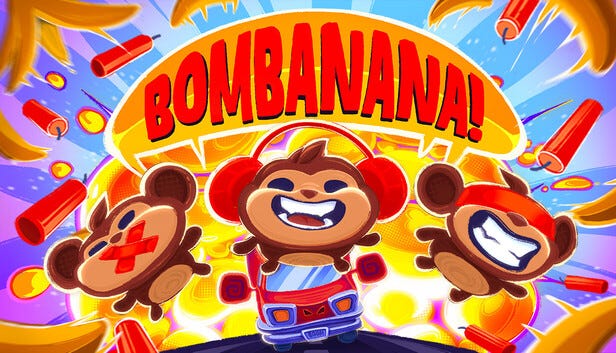
Valve’s official most-played list for June 15 to 18, published June 22, put BOMBANANA at #1 and IRON NEST at #2. Read those two together and the entire report writes itself.
BOMBANANA, a co-op bomb defusal game from indie team Lefto Studio, drew more than 675,000 players across the festival. At its peak, more than 40,000 people were playing at once, per SteamDB, the third-party site that tracks Steam data publicly. The rating held at 92.7 percent positive.
IRON NEST is the argument. Two developers, Nick Nieuwoudt and Dominik Latos, entered the festival with more than 250,000 pre-existing wishlists. Built over months of developer diaries, community engagement, the demo that was live long before June.
Across the full festival they added approximately 200,000 wishlists, developer-verified; the 124,622 figure cited in early coverage was a five-day mid-event snapshot, not the total.
The gain came on a near-linear daily curve, not a day-one spike, which is what an engaged community converting looks like. The demo finished at 99 percent positive from more than 2,590 reviews, earning Overwhelmingly Positive, the highest rating band Steam awards, and Kotaku called it the best demo it had ever played on Steam.
IRON NEST is simultaneously a craft story and an amplification story, and the two are sequential rather than in tension. The craft built the community over months. The community converted into the #2 slot. Strip either half and the result changes. It did not break the harvest pattern. It is the pattern’s clearest single expression at scale.
The rest of the top 10 confirms what GameDiscoverCo observed: the monoculture has fractured. An anime MMO from Bandai Namco, a souls-like extraction RPG, a cozy co-op offroad game from the Art of Rally developers, a Titanfall-style shooter, an RTS, a co-op Lovecraft horror, a bureaucracy sim, and one AI-disclosed dark fantasy MMORPG from Nexon.
Ten different filter bubbles rather than one dominant zeitgeist. Genre stopped predicting the winners in this field. What does predict them sits upstream of genre, and the two names at the top of the chart just demonstrated it.
How the Machine Actually Sorts
Valve’s ranking architecture has been stable since the post-October 2024 recalibration, and by now it is well understood:
Days 1 and 2 are randomized: every game gets equal exposure regardless of size, and store page conversion does the work.
From Day 3, ranking pivots hard to engagement: wishlist velocity, median demo playtime, and download-to-wishlist conversion drive placement, and top-tier games see an impression multiplier.
Which means a debut title relying on the festival itself for discovery gets 48 hours of genuine randomized exposure before the machine sorts winners from losers. After that, position hardens. Games that are not algorithm-eligible by Day 3 effectively do not exist for the remainder of the event.
The signals rank in a clear order. Median demo playtime comes first: the healthy session runs 20 to 60 minutes, and bounces under ten minutes suppress ranking from Day 3 onward.
Store page conversion comes second, and it is bigger than most teams assume, because 68 to 88 percent of wishlists come from players who never launch the demo at all.
That means the capsule, the small storefront image a player scrolls past, carries more weight than the build behind it. The pre-fest wishlist base is third.
Every Diamond-tier earner in the data set, the 10,000-plus wishlist gainers, entered with at least 3,000 wishlists already banked. Most entered with 10,000 or more.
The Determinant Most Western Studios Still Ignore

Eight of the top 10 most-wishlisted games in the June 2026 early charts were reported as coming from Taiwanese publishers.
That is not an anomaly. It is the output of two years of systematic optimization: strong tag selection, polished trailers, and fully localized store copy across multiple Asian languages, aimed at an event East Asian publishers identified as the optimal PC-market entry vehicle while most Western studios were still treating it as an indie showcase.
The through-line runs back through every recent edition. Vindictus topped June 2025 outright for Nexon. At that same event, 68 percent of Stellar Blade’s 192,000 concurrent demo players were Chinese, for a PlayStation-published game that was never marketed as a China-first title.
In February 2026, Simplified Chinese was the second most common localization language across the entire field: 46 percent of all 3,449 entries carried it.
The practical implication is blunt. A game entering October 2026 without Simplified Chinese localization is opting out of one of Steam’s largest player segments, and locking itself out of the Bilibili creator ecosystem, which mirrors Western YouTube and Twitch in scale.
That is not a neutral decision. It is a ceiling on discovery, self-imposed.
The AI Quarter of the Field
Valve requires developers to declare on the store page when a game ships content made with generative AI. That declaration is the disclosure, and the numbers around it need one sentence of hygiene before they mean anything; because most coverage cites whichever figure is larger without naming its population.
Of the 4,382 demos in GameDiscoverCo’s tracked pool, 1,163 carried Valve’s AI disclosure: 26.5 percent. Across the full event of roughly 8,682 entries, the rate is nearer 20 percent. Both numbers are real. They describe different populations.
The clean comparison is the tracked demo pool measured the same way twice: 21.2 percent in February 2026, 26.5 percent in June.
That five-point jump in one edition is the actual trend, and the leading indicator sits above it. In the week before the festival opened, 40 percent of all new Steam releases carried an AI disclosure. The festival rate is chasing the release rate.
Performance is where it gets stark.
Against a demo pool disclosing at 26.5 percent, exactly one AI-disclosed title made the most-played top 10: Embers of the Uncrowned, a dark fantasy MMORPG from Nexon, a publisher with roughly 9,800 employees whose brand trust offsets disclosure hesitancy. That is brand immunity, not a model an indie can copy.
The honest caveat belongs here too: no public dataset compares disclosed and non-disclosed games on wishlists across a fest, so the top-tier absence is a pattern, not a controlled result. But it is a pattern that has now held across every edition with data.
The mechanism is player-built. Valve’s disclosure carries no formal penalty; informed players constructed one anyway, checking for the flag, skipping on sight, feeding the algorithm a weak-engagement signal that compounds after Day 3.
And the damage is not confined to the disclosed games. At a quarter of the field, low-effort entries in the randomized early window depress the impression counts of everyone around them, which is precisely the window an unknown handcrafted title needs most.
The full AI breakdown, including the surface-area rule that separates the disclosed games that performed from the ones that died on the capsule image, is its own report.
Short version for now: the teams that disclosed AI and still cracked the top 100 kept it on surfaces players never inspect, backend localization, procedural text, replaced placeholders, and never on the first image a player sees.
The disclosure is identical in both cases. The outcome is not.
The Next Steam Nest Fest: October 19 to 26

October 2026 runs October 19 to 26, and at the current 66 percent year-over-year growth rate the field could approach 5,500 entries. The June data converts into allocation guidance directly.
The pre-fest wishlist base is the campaign. Target 8,000 before the doors open, stretch to 12,000, and treat 2,000 as the hard floor below which a game is algorithm-invisible after Day 2.
The demo needs to be live by August; every top performer in June had a build available months in advance, and the submission deadline is a floor, not a strategy.
Design the demo session for 30 to 45 minutes. Get keys to at least twenty relevant creators before the Press Preview opens, because the 11-day preview window with its optional embargo is where Day 1 momentum is actually built.
Complete Simplified Chinese localization before registration, not after. And if the game is a roguelite, the run-based genre built on dying, upgrading, and going again.
The differentiating mechanic has to be visible in the first ten seconds of the trailer; at a category median near 900 wishlists, the genre tag alone is table stakes, and the formula that produced concentrated gains in June was a familiar core with one surprise layer that is not legible from the tag.
A studio asking how to win Next Fest is asking the wrong question. The right question is what the wishlist trajectory looks like between now and October 12, the expected registration deadline.
Every Diamond-tier game in the data set had already answered it before June 15.
The Reframe
Steam Next Fest is no longer a discovery engine. It stopped being one somewhere between 900 demos and 4,900. It is an amplification engine, and its input is the one asset in the entire funnel that cannot be purchased, spoofed, or diluted by a field that keeps growing faster than the attention it competes for.
Three years of data, eleven editions, every genre cycle from survival to extraction to co-op, and every genuine breakout from Enshrouded to Balatro to Windrose to IRON NEST arrived the same way: community first, festival second.
You do not go to Next Fest to be found. You go to harvest what you already grew. The studios that win October have roughly fourteen weeks left, and the ones that win February 2027 started already.
Abbas Saleem is a Principal Consultant at Llama & Griffin, advising game studios, streaming platforms, and investment funds across six continents. He writes The Pattern Recognition: gaming industry intelligence 12 to 24 months before it becomes consensus. LinkedIn | Schedule a call