
The Four Community Engines that Market Your Game
Push-marketing just cost Sony a billion dollars at Bungie. Three other engines are running the games that actually launched in 2026. Here's how to tell which one your studio is on.

TL;DR
There are four game marketing engines a game can be built on in 2026. Three of them work.
Engine 1: Push without a community: Dying. Concord and Marathon. Sony has booked roughly a billion dollars in Bungie-related impairment charges since 2022.
Engine 2: Built for too narrow an audience: Starving. Stormgate. Built by ex-Blizzard veterans, ~30 concurrent players on Steam.
Engine 3: Memetic participation: Works. Helldivers 2. Cultural lineage already loaded, community wider than the playerbase.
Engine 4: Built-in shareability: Works. Dead as Disco, Burglin’ Gnomes, Far Far West, Content Warning. Gameplay loop produces shareable content as a byproduct of being played.
Studios that ship in 2026 without picking Engine 2, 3, or 4 have already chosen Engine 1 by default.
The slide came in over Discord over the last week.
Jay Rooney dropped the screenshot into a thread without comment: an unnamed agency’s diagnosis of why Concord failed.
Distribution problem, the slide said. Sony couldn’t reach players. Wishlist signals were murky. Users who signed up never came back. Their prescription: more touchpoints, better engagement infrastructure, a claimed “3.7x results improvement” from agency services.
Sebastian Cardoso saw it before I did (I would like to blame timezones but I was in bed playing Pragmata). Sebastian writes about ground-level production and project management, and he had been in a different conversation about Concord around the time the reveal trailer dropped. His one-line review at the time was that the cast looked like the Temu Guardians of the Galaxy.
That is what made me start writing: There are four community engines a game can be built on in 2026, three of them work, and the slide circulating right now understands only the one that doesn’t.
This piece is about all four: the two that are dying, the two that are quietly running games of marketing in 2026, and how to tell which one your studio is actually building on.
The Framing
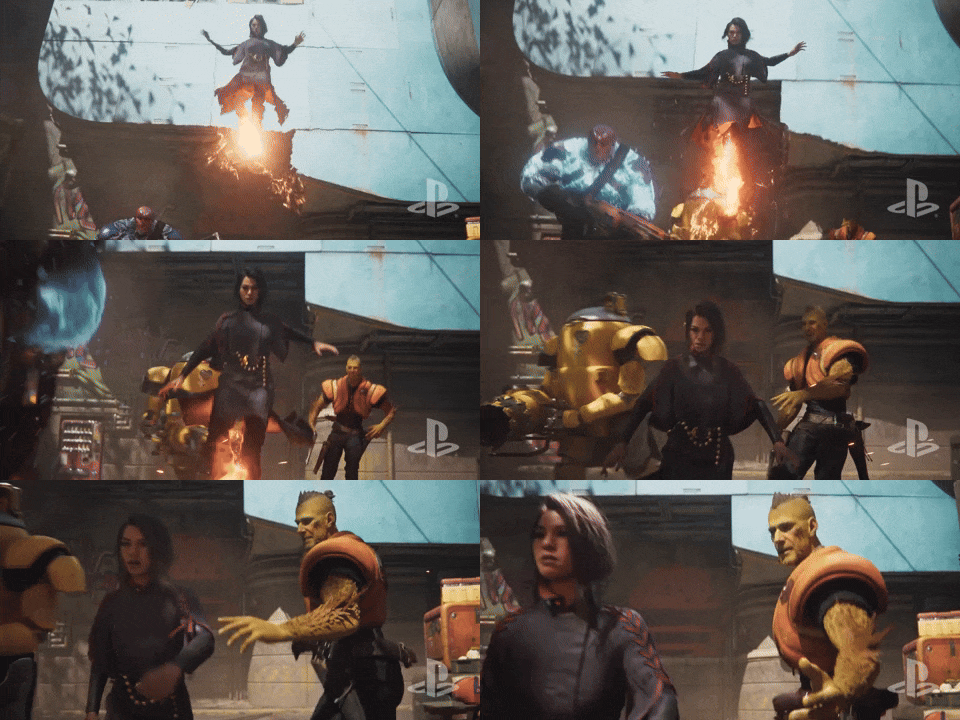
Concord had 4,126 wishlists on Steam at the time of the slide’s analysis. Marvel Rivals had 69,293 at a comparable moment. STALKER 2 had 217,854. The audience the slide says Sony failed to reach did not exist, and the audience that did exist had already accumulated 30,000 dislikes on the reveal trailer in the first week. Players were not unreachable.
They told Sony exactly what they thought, and Sony shipped Concord anyway.
Concord shut down within weeks of launch. Sony took a roughly $204 million impairment hit on a separate Bungie line item the same year. The slide is still in circulation. The shopping list is the problem.
The more interesting question isn’t why Concord failed. It is what the slide cannot see: there is more than one way for a game to have a community in 2026, and picking the wrong one is exactly as fatal as having none at all. There are four engines in the field.
Engine 1. The Concord Model: Push Without A Community
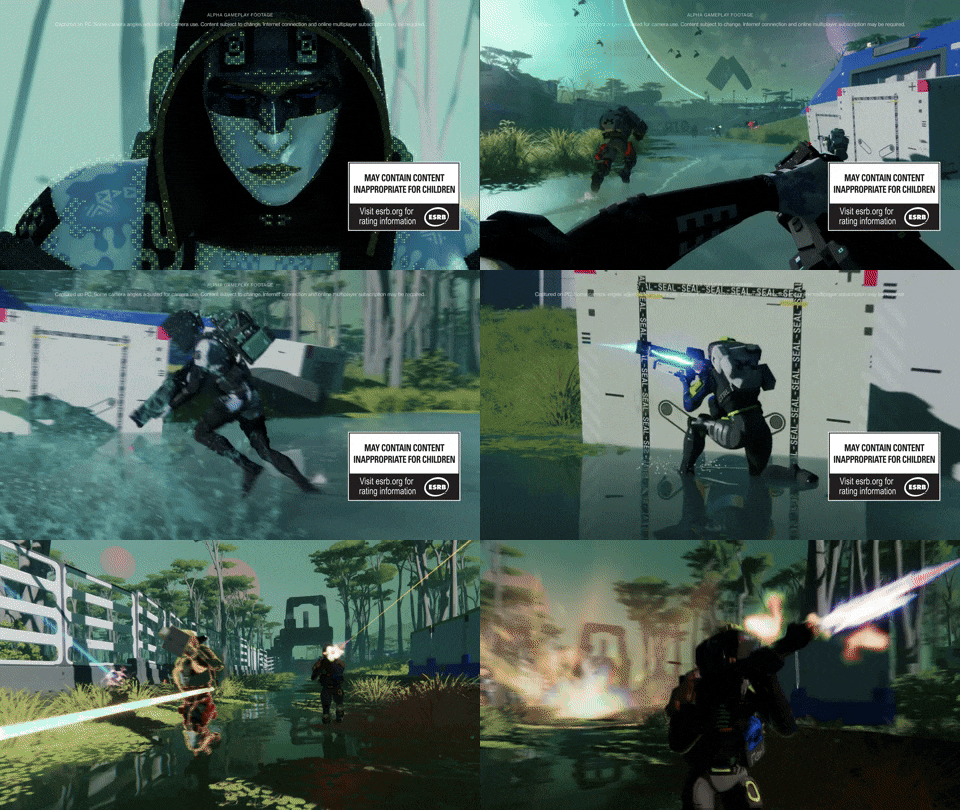
Engine 1 is the publisher’s marketing engine pointed at an audience that does not exist. Sony’s PlayStation marketing engine is one of the most powerful in entertainment, and it could not save Concord. Eight years of development. Reportedly hundreds of millions in production cost. 697 concurrent players at launch. Shut down within weeks.
If that read like a bottom-of-the-market problem, it isn’t. Sony acquired Bungie for $3.6 billion in 2022 for the live-service playbook. Four years and roughly a billion dollars of Bungie-related impairment charges later, that bet is being unwound on Sony’s own balance sheet.
Marathon shipped, peaked at 88,337 concurrent Steam players, collapsed 80% in eight weeks, and triggered a $765 million write-down on its own.
Concord is the cheap version of this mistake. Marathon is the expensive one.
The shape is identical: a game built without a community foundation, pushed into an audience that did not exist on the other end of the push.
None of this is a marketing problem. It is enterprise behavior.
Platform holders stopped treating community as substrate years ago: They built around the assumption that they could run live-service ecosystems migrating players between titles every three months; similar to the way a Facebook social game shop ran cross-promotion in 2012.
That assumption is now being unwound on Sony’s balance sheet; and they are not the only platform holder where the internal picture is worse than the public narrative.
The slide tells studios to push harder. Sony’s accountants are now writing down what happens when you do.
Engine 2. The Stormgate Model: Built For The 20%
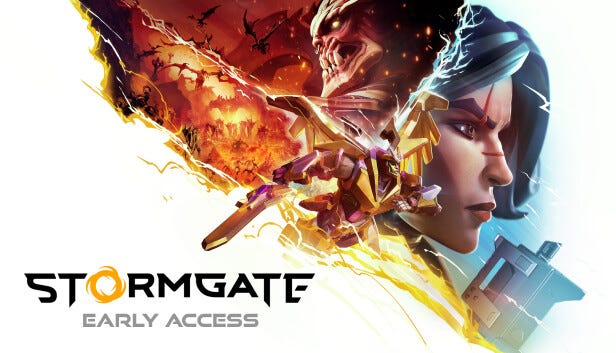
Stormgate is the more useful failure case: Frost Giant did almost everything right except the one thing that mattered.
The studio is veterans. Ex-Blizzard. The people who shipped the StarCraft games most of us grew up on. The technology is solid. The competitive design is thoughtful. Rollback netcode, asymmetric factions, a clean 1v1 ladder. All of it is professionally built.
Stormgate has roughly 30 concurrent players on Steam as of this writing. Mostly Negative recent reviews. The open beta peaked around 4,500. It never recovered.
What happened is a community design error, not a development one. RTS is a genre where, in my experience working with studios in this space, roughly 80% of the audience never plays online at all. They want a campaign. They want a story to walk through, set-piece missions, a payoff.
The competitive 20% is loud and visible: You see them on Battle.net, on tournament streams, on Reddit. They are not the audience.
The single-player audience showed up, played the prologue, and left. The competitive audience showed up, found a game smaller than StarCraft 2 with most of StarCraft 2’s friction, and went back to StarCraft 2.
Live-service is not a community. It’s a delivery mechanism.
If the community model underneath the live-service is wrong, the live-service infrastructure becomes overhead. Bungie can absorb that overhead for a few quarters before the auditors notice. Frost Giant cannot.
Engine 3. The Helldivers 2 Model: Memetic Participation
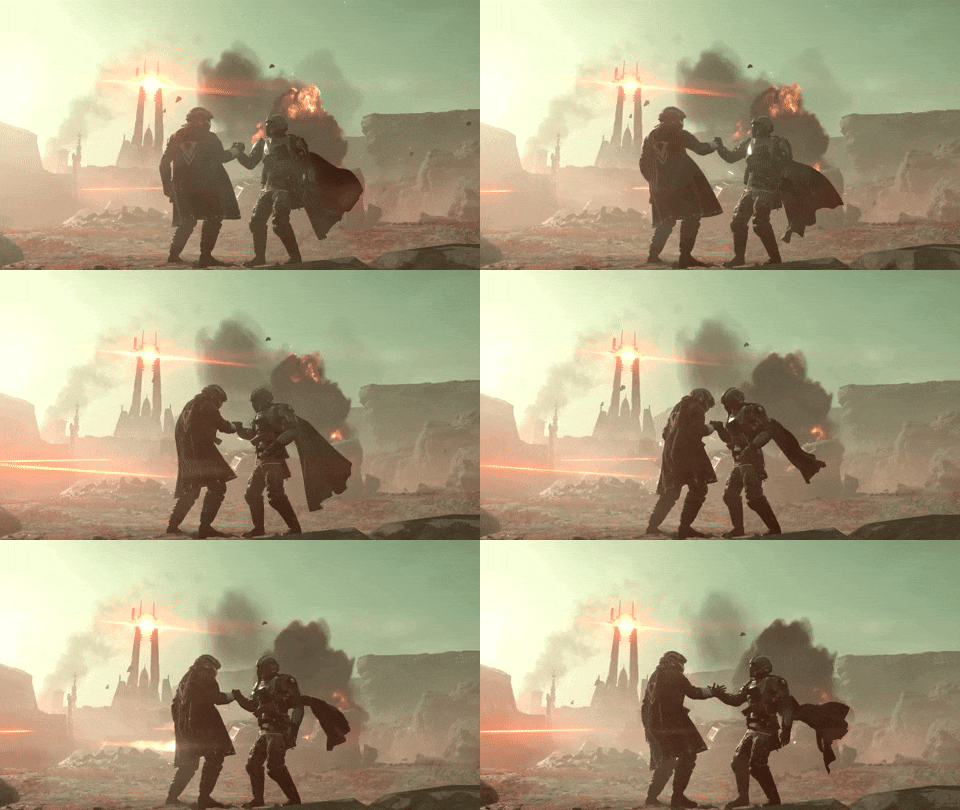
Sony also publishes Helldivers 2.
Helldivers 2 sold more than 12 million copies in its first months in 2024 with almost no paid marketing. The reason it worked is community-shaped, but it’s a different shape from the one Brain Jar built.
Helldivers 2’s community is memetic. The game inherits the cultural DNA of Starship Troopers, which a generation of viewers absorbed as ironic anti-fascist satire. Arrowhead amplified that lineage.
The player is a Helldiver fighting for Super Earth, exporting Managed Democracy at gunpoint to alien insects. The fascism is the joke.
That joke landed in 2024 because the political moment had a generation of players watching their personal agency over their own lives evaporate (cost of living, climate, war, institutional rot, whatever the local flavor was) and looking for somewhere to laugh about it. Helldivers 2 gave them a target.
Players made posters, recruitment videos, mock-historic accounts of the campaign. The Galactic War metagame stitched all of it together into something that felt like a participatory war story.
Here is what’s structurally important about that model: the community is wider than the playerbase.
There are people who follow the Helldivers 2 lore on TikTok and Reddit who have never played the game and never will. They participate in the meme. They consume the videos. They recognize a Malevelon Creek reference.
When a friend asks if they should buy the game, they say yes, because they have already been a citizen of Super Earth for months without owning it.
You cannot manufacture this on a marketing call. It comes from picking a piece of cultural lineage that’s already loaded, and being good enough at parodying it that the parody itself becomes a sharable artifact.
Engine 4. The Built-In Engine: When The Game Is The Marketing
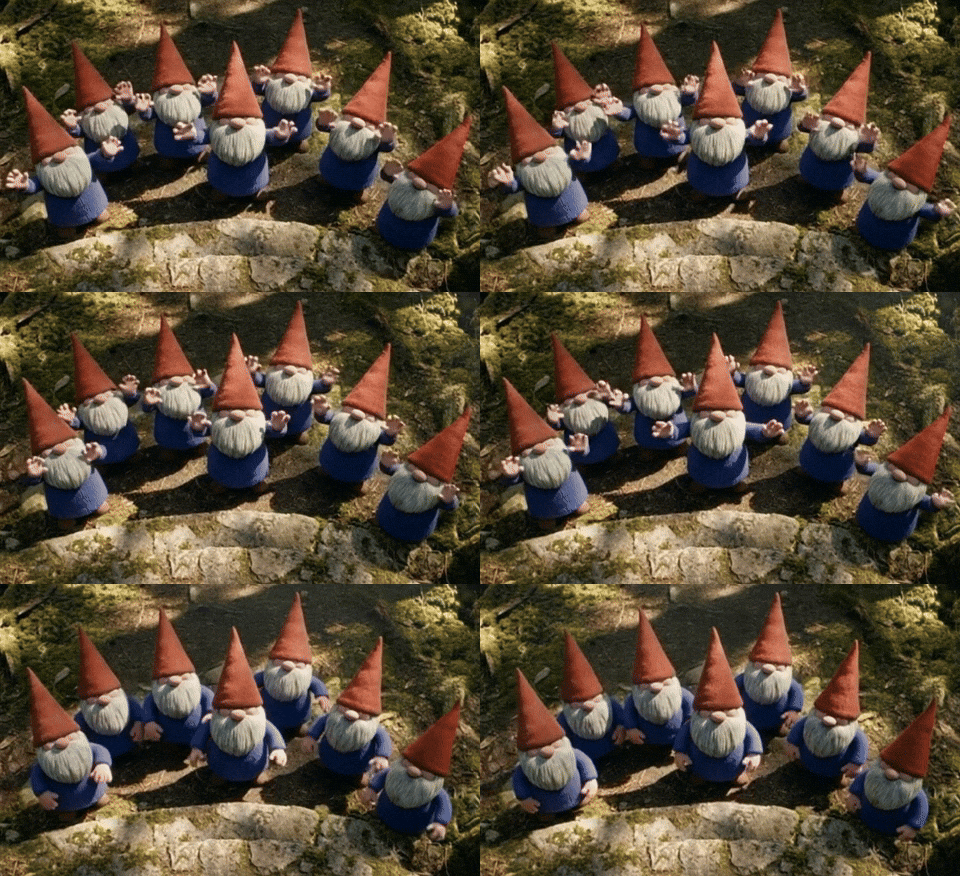
The fourth model is the one I wrote about most recently with Brain Jar Games and Dead as Disco. It’s the newest of the four and the most interesting, because it doesn’t ask the studio to build a community before launch.
It asks the studio to build a mechanism that produces community once players show up.
Dead as Disco does this through Songcrafter.
Players import their own music; the game generates a beat-synced fight around it; every fight becomes a personalized music video that doesn’t exist anywhere else.
87% of demo players used the feature. TikTok drove more than 50% of the wishlist traffic. 1.2 million demo players. 300 million-plus video views. More than 750,000 wishlists going into Early Access. No publisher.
Burglin’ Gnomes did the same thing with a different mechanic.
Six-player physics-based heist comedy, designed so that nothing ever goes the way it was supposed to. Every demo session is a different disaster.
A solo developer in the Netherlands released the demo three weeks ahead of Steam Next Fest, and watched it peak at 26,645 concurrent players before the fest even started.
It doesn’t have a Discord that matters. It lives on YouTube Shorts. The game is the channel.
Far Far West did it through co-op tone.
A Helldivers loop pacing for people who want to hang out.
A six-person team, two shipped games of trust collateral, more than 500,000 wishlists going into Next Fest.
The Pattern Goes Back Further
Lethal Company was the proof case in 2023.
The horror hinged on proximity chat: voice that only carries between characters who are physically close in-game, so the panicked breathing of the friend three corridors away cuts in and out as you move. The result was genuinely funnier on a Twitch stream than it was when you played solo.
Content Warning made the engine literal: the game’s premise is that you’re recording videos of monsters to upload to an in-game social platform called SpookTube. REPO, Schedule I, PEAK. Same family. Different species. Each one is a game whose gameplay loop produces shareable content as a byproduct of being played.
The studio doesn’t run the channel. The studio built a thing that becomes the channel when players touch it.
I have watched this play out in consulting constantly: A platform holder buys a studio for the model, then spends three years discovering it does not survive integration into their own publishing logic.
The pattern is not subtle once you see it from the inside. It is just expensive.
Four Questions To Sit With

If you are inside a studio right now, the diagnostic is not “do we have a marketing plan.” It is “which engine are we building on.” Four questions force the answer:
If we cut paid acquisition to zero tomorrow, what does our community look like in twelve months? If the answer is “smaller than today,” you are running Engine 1.
What artifact does our gameplay loop produce that a player would share with someone who does not play games? If the answer is “nothing specific,” you do not have Engine 4.
Who is the audience that exists outside our playerbase, and what cultural lineage are they already carrying when they encounter our game? If you cannot name it, you are not running Engine 3, no matter what your trailer looks like.
What percentage of our content roadmap depends on players actively engaging with the game versus passively consuming the lore around it? If those numbers are flipped from the reality of how your community lives, the roadmap is wrong.
These are not opinions. They are decisions a founder or a publisher has to make before the production budget gets locked.
The studios I work with that answer them honestly, even when the honest answer is “we picked the wrong engine,” save themselves twelve to eighteen months of misallocated capital.
The studios that defer the answer because the slide deck told them the marketing layer would handle it are the ones writing down assets four years later.
The Reframe
There are four community engines a game can be built on:
Engine 1 is push without a community, and it is dying at every price point.
Engine 2 is community designed for too narrow a slice of the audience, and it is starving.
Engine 3 is memetic participation, and it works when the cultural lineage is already loaded and the parody is sharp enough to share.
Engine 4 is built-in shareability, where the game itself produces the artifact that creates the audience.
The agency slide pitching Concord-as-distribution-failure to studios in 2026 has only Engine 1 in its head, and it will tell them this is fine. The 4,126 wishlists on Concord will tell them otherwise. The 30 concurrent players on Stormgate will tell them otherwise. The roughly billion dollars Sony has now written down at Bungie will tell them otherwise.
The model is the bet. Pick badly and no marketing budget on Earth saves you.
Abbas Saleem is Principal Consultant at Llama & Griffin, working with game studios across six continents. He writes The Pattern Recognition, providing gaming industry intelligence 12 to 24 months before consensus.
Funny watching this piece come together from that screenshot in the thread. Good reframe; the marketing engine is a pre-production decision, but the slide can’t see it because it’s diagnosing at the marketing layer.
The Stormgate cut is the most instructive, imo. Concord is easy to dismiss, a perfect storm of atrocious creative judgment followed by ignoring an audience that shouted “NO!” from the rooftops. I reckon most studios reading this won’t make that mistake. But they’ll make Stormgate’s; industry veterans, professional execution, and all the technical work in place, along with a community built for the loudest 20% of an audience which was never going to carry the game. All the ex-Blizzard people in the world can’t ameliorate that failure mode.