
The Roguelite Cull Hasn’t Happened Yet. The Data Already Decided It.
Slay the Spire 2, Megabonk, and 33 Immortals aren’t survivors of a graveyard that doesn’t exist yet. They’re proof the mechanism is already running. A structural read on what mid-2026 data already con

TL;DR
Roguelite: short, repeatable runs where death resets your progress within that run, not what you’ve permanently unlocked. Think Hades, Slay the Spire.
Roguelite revenue on Steam hit $400 million in 2025, up 80% on 2024, and nearly $500 million in the first half of 2026 alone.
Slay the Spire 2 pulled in an estimated $108 million in March 2026 and 6.5 million copies by mid-May. Megabonk and 33 Immortals are proving the same pattern from opposite directions.
Valve moved the Popular Upcoming wishlist threshold from roughly 7,000 to over 100,000 in June 2026, replacing it with a more targeted Personal Calendar feed.
Put together: an oversupplied 2022 to 2024 cohort is launching into a market where discovery just got harder and revenue is more concentrated than ever. That’s the cull.
A founder messaged me in June asking whether he should push his Q1 2027 launch back a quarter. I asked him what he thought would be different by then. He didn’t have an answer beyond “more runway.”
More runway doesn’t fix a structural problem, and what’s coming for the 2022 to 2024 greenlight cohort is structural. Not a bad-luck pile-up of too many similar games landing in the same quarter. A market that has already, visibly, rewritten its own rules while most of that cohort was still in production.
The forecast part is which specific studios don’t make it. The proven part, already sitting in Steam’s own data, is why.
The Concentration Is Already Here
Slay the Spire 2 launched into Early Access on March 5, 2026, at $24.99, and absorbed most of the genre’s growth for itself.
Within two days it had passed 430,000 concurrent players. By day three SteamDB had it at an all-time peak of 574,638, over ten times the original’s peak.
Alinea Analytics put March sales at 5.3 million copies and $108 million in revenue, ahead of Crimson Desert’s 2 million and Resident Evil Requiem’s 1.2 million combined. The total kept climbing to 6.5 million copies by mid-May.
Set that next to what most roguelites are actually shipping into. The median indie title on Steam clears somewhere in the low five figures lifetime, and roguelite-specific estimates vary too widely to quote a single firm figure here without better sourcing.
Whichever number turns out right for the genre, the shape doesn’t change: this is a superstar market, not a rising tide.
Genre revenue on Steam climbed to roughly $400 million in 2025 and nearly $500 million in the first half of 2026 alone. The top of the distribution is capturing nearly all of it.
Everyone building towards Q1 2027 is building into a market that already looks like this.
One methodology note worth keeping in view: those Alinea figures are a model, not a Mega Crit confirmation.
No developer is obliged to release sales data, and Mega Crit hasn’t. Treat the estimate as strong and track-recorded, not as company-confirmed revenue.
The Supply Curve and What Next Fest Actually Tests
The 2022 to 2024 greenlight cohort didn’t walk into a crowded market by accident. It walked into one that had been getting more crowded every year.
That trend was visible in SteamDB’s own release data the whole time:
Annual roguelike and roguelite releases climbed from 432 in 2021 to 1,926 in 2025.
October 2025 alone set a single-month record of 191 releases.
The genre’s cumulative Steam catalogue grew from roughly 1,447 titles at the start of 2022 to 4,802 by the end of 2024, more than tripling in three years, and had passed 6,700 total releases by the end of 2025.
None of that happened quietly. Every studio greenlit in this window watched the shelf get more crowded in real time.
What Next Fest Actually Tests
Steam Next Fest is where that crowding becomes visible in real numbers. The mechanism matters more than the headline.
Alinea Analytics’ Rhys Elliott put it plainly after February 2026’s edition:
Next Fest has stopped functioning as a discovery engine and become, in his words, a stress test for pre-existing momentum. The games that gain the most wishlists are overwhelmingly the ones that already had momentum walking in.
Windrose is the cleanest illustration on record. The co-op pirate survival game from Uzbekistan took the top spot in February 2026 with 351,000 new wishlists in a week, past 1.3 million total.
That result wasn’t built during the event. It came from a Discord community that grew to 40,000 members over the prior year.
The same pattern held eighteen months earlier. Nine of October 2024’s top ten most-played demos featured multiplayer or co-op mechanics.
The one roguelite that broke in was Windblown, from Dead Cells developer Motion Twin. Franchise recognition and its three-player co-op structure pulled in roughly 500,000 wishlists..
The event itself keeps getting bigger, which raises the bar rather than lowering it. Simon Carless’ GameDiscoverCo newsletter put June 2026’s edition at 4,382 demos, up 66% on the 2,645 demos in June 2025, the platform’s largest Next Fest to date.
A studio that hit the top 10% of participants in June 2025 needs a meaningfully larger following to hit that same percentile a year later, in a field that grew by two-thirds.
Two patterns repeat across every edition this covers, and both compound the concentration problem already laid out above:
Co-op and social mechanics consistently outperform solo action loops at the discovery layer.
Franchise or IP recognition acts as a multiplier on an audience that already exists, not a way to build a new one.
Both are visible in every Next Fest since 2024.
What Valve Actually Changed, and When
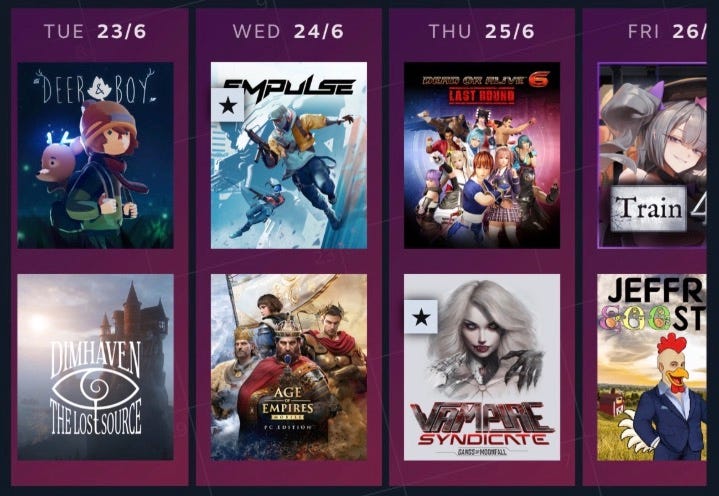
Two platform-level shifts landed in the first half of 2026, and both are already public record, not forecasts.
First, Steam’s Popular Upcoming tab, which used to run chronologically by release date, went fully algorithmic in June. Indie marketing analyst Chris Zukowski’s tracking, reported by Inven Global, lays out exactly what changed:
Old Popular Upcoming: roughly 7,000 wishlists to qualify, one or two days of visibility.
New Popular Upcoming: roughly 100,000 to 120,000 wishlists to qualify, a threshold almost entirely out of reach without a major publisher’s marketing spend.
New Personal Calendar: 8,000 to 30,000 wishlists to qualify, a personalised feed built from each user’s own wishlist and play history, with exposure running two months before launch through a month after.
Valve didn’t just close a door, it opened a narrower one. The Personal Calendar is a worse tool for studios counting on volume alone. It’s a genuinely better one for studios that had already built a specific, identifiable audience before launch.
That distinction, generic reach versus targeted reach, is the axis this whole piece keeps returning to.
Second, Valve quietly shifted weight away from the wishlist funnel most 2024 and 2025 greenlights were built around, towards engagement metrics instead: daily active players, session length, post-launch content cadence.
A one-and-done roguelite with a strong opening loop and no live content plan is exactly the shape of game this shift punishes, no matter how good the first two hours are.
The studios shipping into Q1 2027 greenlit their games before either change existed.
The Genre Mismatch, If the Sourcing Holds
One more piece is worth naming, directional rather than independently verified.
The 2022 to 2024 pipeline skews heavily towards the most over-supplied corner of the market: run-based action roguelites and Vampire Survivors-style clones.
That’s exactly the moment player demand and Steam’s algorithm are both rewarding systemic depth over surface loops instead.
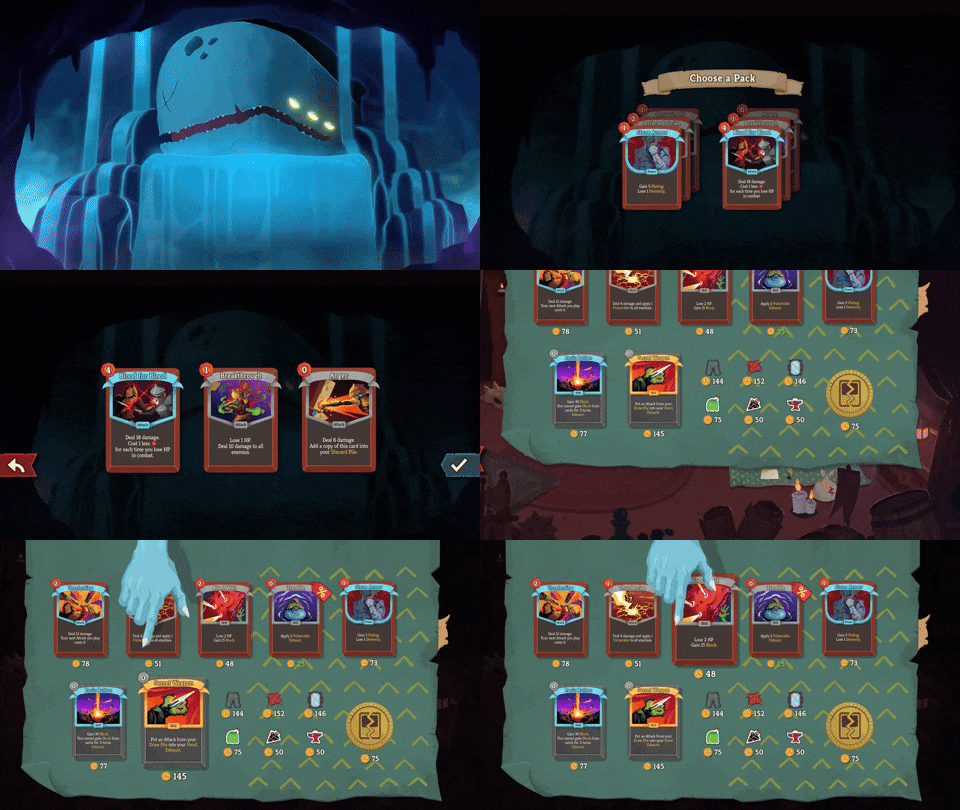
Deckbuilders and management-adjacent roguelikes show meaningfully higher breakthrough rates than action-roguelite clones, which tracks with everything else here.
Specific percentages stay out until there’s a checkable source. Send the link and they go back in, properly cited.
The Failure Patterns to Watch For, Not the Casualties to Name
This is the point where the original draft named specific studios as already dead. That’s been pulled back, deliberately. Nobody has died yet. What’s real is the pattern that decides who does.
The Clone. Greenlit in 2021 or 2022 off the Hades or Vampire Survivors wave. Shipped in late 2026 or Q1 2027, into a tagged genre that had already passed 1,600 releases the year before. Nothing wrong with the game, nothing right about the timing.
The Sequel Trap. Franchise equity from a first game doesn’t buy immunity from a market that moved while the sequel was in development. The exception: Slay the Spire 2’s audience was 39% first-timers, not recirculated fans, because Mega Crit did real design work rather than leaning on franchise recognition alone.
The Mid-Tier Generic. Competent, polished, well-reviewed, and invisible: too broad for a niche community, too finished for the engagement-weighted algorithm to keep promoting.
The Under-Community’d Launch. Built its pre-launch strategy around the Steam wishlist funnel exactly as that funnel was being restructured, with no Discord, no creator relationships, no owned audience to fall back on.
None of these are predictions about named companies. They’re the shape of the risk. Any studio heading into Q1 2027 can check itself against all four right now, months before launch, while there’s still time to do something about it.
The Proof Is Already Live, Not Hypothetical
The studios that demonstrate these winning patterns already exist, and they’re already winning, in July 2026.
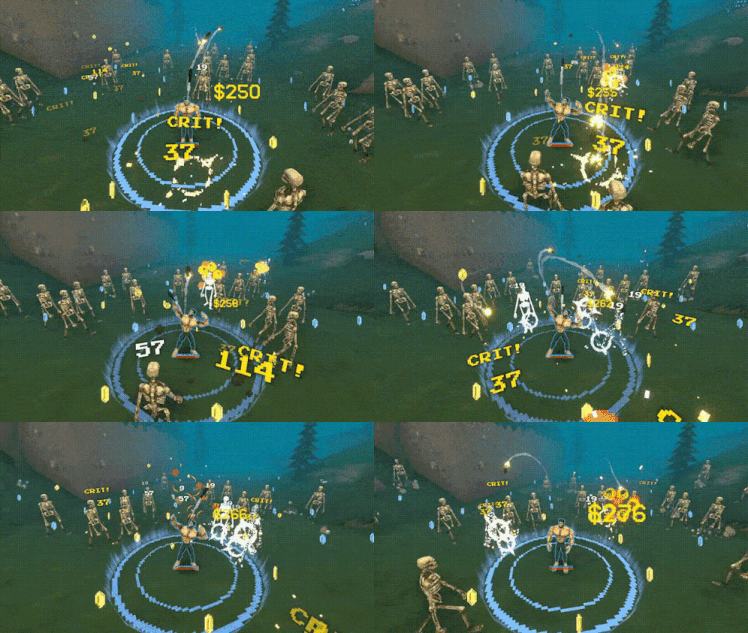
Systemic depth over surface mechanics. Megabonk launched in September 2025 into the worst possible release week, wedged between Hollow Knight: Silksong and Hades 2, and still hit an all-time peak of roughly 117,000 concurrent players. Nine months later it’s still cited as one of the only roguelikes standing ahead of 2026’s big releases. The mechanic isn’t the product, the endlessly recombinable build space is.
Social architecture as the core product, not a bolt-on. 33 Immortals spent fifteen months in Early Access before exiting to 1.0 on June 10, 2026, built entirely around funnelling 33 players into a run together, narrowing to 22 then 11. Thunder Lotus held it off Steam during Early Access on purpose, launching first on Epic and Xbox Game Pass. Community size as a design constraint, not a marketing afterthought.
Depth that survived the mechanical comparison entirely. Slay the Spire 2 didn’t win because deckbuilders are trendy. It won because Mega Crit owned a specific run structure players had already spent years wanting more of, and nobody else had replicated it convincingly.
The pattern underneath all three: a roguelite’s retention mechanism has to be a deep system, not a surface loop. A dodge-shoot-upgrade cycle is easy to enjoy and easy to copy. A build space that keeps generating combinations players didn’t expect is what actually produces the community vocabulary, the build names, the streamer moments, that keep a game alive past its first content wave.
What Concentration Already Looks Like
The specific Q1 2027 revenue-share table from the original draft has been cut entirely.
Every number in it, the exact percentage of genre revenue captured by the top 1%, the precise survival rate for the bottom 70%, described an event that hasn’t happened. Presenting invented precision about an unconfirmed future as a data table is exactly the failure mode this piece argues against everywhere else.
The concentration already established above doesn’t need a fabricated table to make its point.
If that pattern holds into Q1 2027, and every structural force in this piece points towards it holding, the studios without a specific answer to what only their game offers are the ones exposed. That’s a directional call, not a percentage table, and it’s better to be right about the shape of it than confidently wrong about numbers nobody can check yet.
Diagnostic: Is Your Studio Building Into the Mismatch?
Run this now, not after you ship.
Can you name the five most-played builds in your game before launch? If yes, your community already has a vocabulary. Real signal.
Does explaining why your game is fun require a comparison to another game, or does it require describing something only yours does? The second answer is the one that survives an algorithm built around engagement time.
What does your game give a streamer that no other roguelite does? If that doesn’t fit in one sentence, there isn’t a streamer-native product yet.
Is there a Discord, or an equivalent owned audience, with real active engagement before the marketing push starts? If not, the plan is built towards the exact funnel Valve just narrowed.
Does the systemic depth hold past fifty hours? If it doesn’t, the game was built for the refund window, not for the engagement metrics the algorithm now weights.
Answer all five cleanly and the build is aimed at the market that exists right now.
Answer fewer than two and it’s aimed at the market that existed in 2022, a more crowded, less forgiving place to launch into.
The Reframe
The mechanism that will decide which Q1 2027 roguelites survive isn’t a forecast. It’s already running, in public, checkable by anyone willing to look at SteamDB, Alinea Analytics’ numbers, and Valve’s own Popular Upcoming changes. The only genuinely unknown part is which specific studios get caught by it, and that’s exactly the part worth being honest about not knowing yet.
Next time: worth tracking is what Q3 2026 Steam data does to this picture once the summer release slate lands. That’s the last real checkpoint before the Q1 2027 cohort ships into whatever the market looks like by then.
Abbas Saleem is a Principal Consultant at Llama & Griffin, advising game studios, streaming platforms, and investment funds across six continents. He writes The Pattern Recognition: gaming industry intelligence 12 to 24 months before it becomes consensus. LinkedIn | Schedule a call
I talk to A LOT of studios shipping roguelites. At the same time, I’m also detecting the early stages of a sort of “roguelite fatigue” in the wider player base; as the genre gets increasingly crowded and further dominates Steam’s discovery surfaces, people are starting to say “enough!” And it’s even more pronounced with deckbuilder roguelites. Vampire Crawlers may turn out to be the last such hit for quite some time (unless you count Slay The Spire 2’s 1.0, but as you mentioned they’re a cut above most other titles in this genre); if you’ve just greenlit a roguelite (and especially a deckbuilder) right now, you’re probably ngmi.
The same thing will happen with friendslop (another genre I see a lot of folks developing for) in a few years, btw… though that wave is still rising and hasn’t quite crested yet, so there’s still time to position oneself to ride it.