
Congratulations, You Ignored the Chinese Games Market. Here's What You Lost.
The China Multiplier, and the studios already winning while Western publishers monitor the market

TL;DR:
Simplified Chinese is now Steam’s most-used language. It crossed 50% during Chinese New Year 2025 and held the annual lead over English across all of 2024.
For well-localized premium PC titles, China is the single biggest market on Steam. Stellar Blade ~56% of sales, Split Fiction ~44%, It Takes Two roughly half of 23 million.
Call it the China Multiplier. For a $50M Steam title outside China, the localization work conservatively adds $20-30M on top, on a spend that rarely breaks $500K.
It scales with three variables, in this order. Pricing posture, localization depth, content respect. Everything else is a footnote.
Forza is the counter-example. 500-plus cars, zero Chinese vehicles, into the country that just took the EV crown from Tesla. Maintenance mode by end of 2025.
The frame has flipped. The question is no longer whether you sell into China. It is how much of your home platform you cede to studios that got there first.
Last year my Chinese publisher partners invited me to ChinaJoy. People I had been working with from a distance for the past year. After a decade of tracking this market in spreadsheets, the invitation itself was its own data point. The relationships I had been building at distance had crossed into something I would call genuine.
I went home that evening and looked at a number I could have pulled from my desk on any given day. After the invitation, it landed differently.
In February 2025, Simplified Chinese became the single most-used language on Steam, crossing 50% of the platform’s opt-in hardware survey for the first time in its history.
Not the Asia-Pacific slice. Not the Mainland-only count. The biggest language bloc on Valve’s entire platform.
The obvious objection is that the 50% is a Chinese New Year spike. Half right.
The part that survives the objection: across the full year 2024, Simplified Chinese passed English as Steam’s most common language outright, 33.7% to 33.5%, the first time any language has done that, on Valve’s own annual data.
I have run this number past Western publisher leadership in more rooms than I want to count. Same reply every time.
“That can’t be right.”
It is right! And Chinese gamers do not play on a separate Chinese Steam. They play on yours. Close to 79% of Chinese PC gamers play premium titles on the international Steam client, most without a VPN, paying in yuan through Valve’s regional pricing system.
The conversation I keep having in 2026 is convincing a CFO that the audience they assumed was someone else’s customer is the largest customer they have.
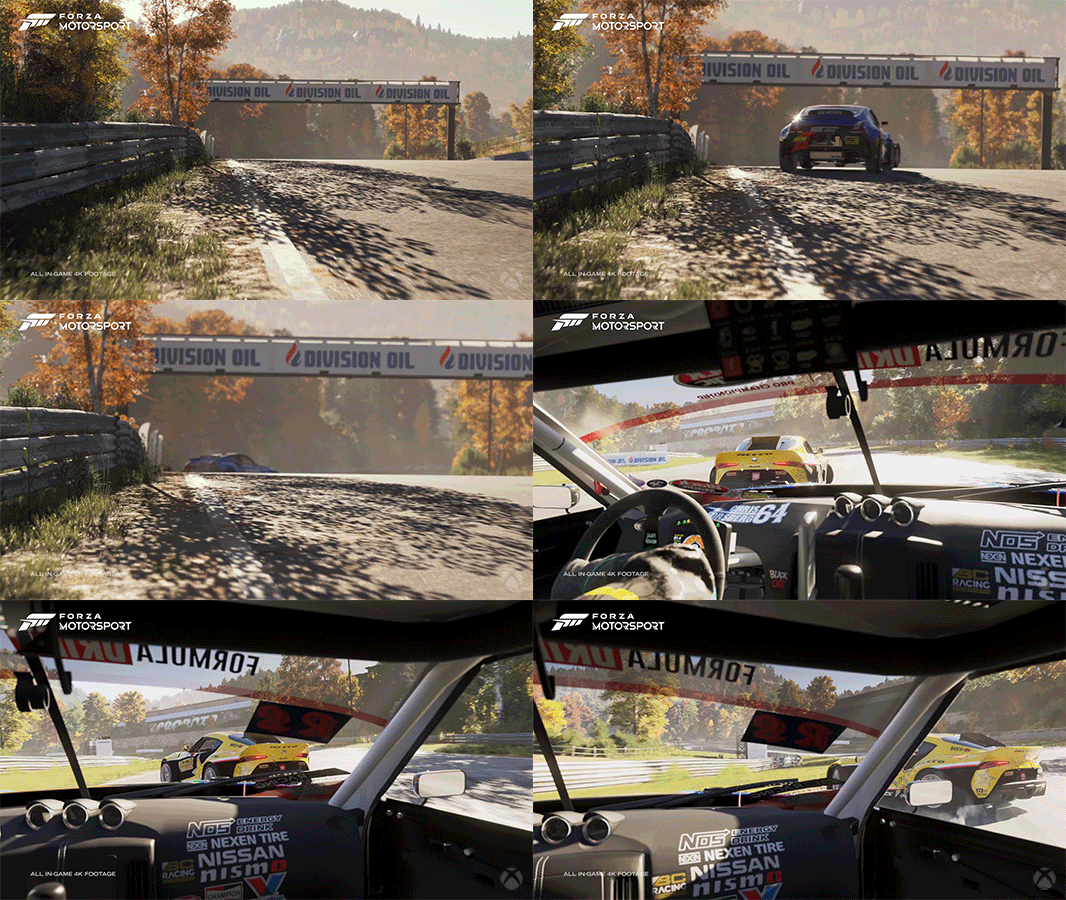
Forza Motorsport: What Not Doing The Work Looks Like
I have not stopped thinking about this one.
Turn 10 launched Forza Motorsport on Steam in October 2023 at $69.99 standard, $99.99 premium. Inside a few months the Chinese price had been cut to ¥198 standard and ¥328 premium, a 58% markdown on the entry tier. A reflexive deep discount hunting for buyers who never showed.
They never showed because the game gave them no reason to.
Forza Motorsport launched with over 500 cars and not one of them was Chinese. In 2023.
The year after BYD took the global electric-vehicle manufacturing crown from Tesla by volume. The performance pedigree was not new either: NIO had set a lap record at the Nürburgring back in 2016 with the EP9.
(The Nürburgring is the brutal German circuit where performance cars go to prove they are real.)
By 2023, Xpeng, Li Auto, Changan, and Hongqi were shipping production cars that out-specced European premium brands at half the sticker price. None of them showed up in Forza Motorsport’s garage.
Here is the part that stings:
Forza Horizon 5, the casual sibling product, had been adding Chinese cars since 2022.
The NIO EP9 and Wuling Hongguang in Series 4. The Chinese Lucky Stars Car Pack in 2024 with MG Cyberster and Lynk and Co.
Each one announced on the Forza China website.
The casual game knew exactly who its Chinese audience was. The serious sim launched as if none of that had happened.
The results: 4,703 concurrent peak players at launch and 43% positive reviews. A Mixed rating that no update could fix.
The game quietly dropped into maintenance mode by the end of 2025: still online, but no new cars, tracks, or features, the industry’s polite way of letting something die.
A Chinese player wrote on the official Forza forums when the news broke:
“I’m not sure if your T10 Game Studio and Microsoft are aware of how many Chinese players are into this game. When I posted the news about Forza Motorsport ceasing updates, it received an overwhelming response from fellow players. All of them expressed deep regret.”
They were there. They wanted to play. The game did not meet them.
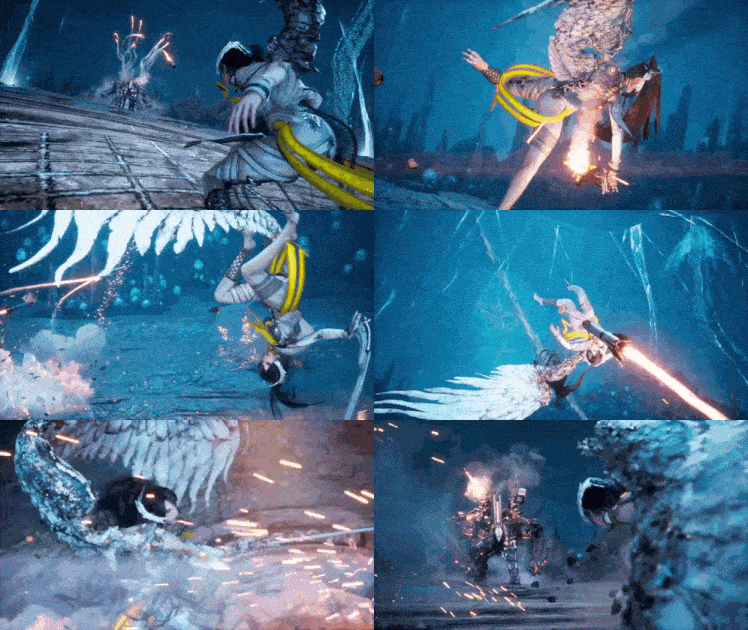
Stellar Blade: What Doing The Work Looks Like
Eighteen months later, the opposite outcome on the same platform.
Shift Up launched Stellar Blade on Steam in June 2025. Within days it became the fastest Sony-published PC title to pass 180,000 concurrent players, meaning people logged in and playing at the same moment.
By the end of launch month it had moved roughly 1.5 million copies. China accounted for around 56% of those sales. The United States contributed around 13%.
Thirteen percent. The single largest English-language market on Earth bought roughly one copy in eight. China bought more than half.
What Shift Up actually did breaks into three moves.
A full Chinese dub with lip-sync. Not subtitle-only. Notably better than the PlayStation version, which never got one.
Regional pricing at ¥268, around $37, against the $60 US baseline. A price that told Chinese players the developer thought they were worth charging properly, not marking them down to clearance.
Real on-the-ground promotion. Actual KOL relationships, actual Bilibili content, actual conversations with Chinese press.
KOL is key opinion leader: China’s term for the creators and streamers who decide what their audiences buy. Bilibili is China’s dominant video and gaming-community platform, roughly YouTube and Reddit fused.
The whole investment almost certainly came in under $500,000. The return was over 800,000 sales from one geography, on one platform, in the launch window alone, before a cent of the long tail.
Same platform. Opposite outcome. The variable was not market access. The variable was respect.
Next Fest Is Now Co-Determined by China
Steam Next Fest, the platform’s thrice-yearly showcase where upcoming games drop free demos and players wishlist what they like, does not plant communities. It harvests communities that already exist.
The pattern has shown up across the last several editions.
June 2024: Once Human. NetEase’s Starry Studio took its post-apocalyptic survival title into Next Fest and swept all three major categories within 24 hours: most wishlisted upcoming, trending upcoming, and most daily active demo players. Industry trackers called it the Triple Crown. The game launched the following month with 10 million downloads in its first thirty days.
February 2026: The Awakener: Battle Tendency. With 3,500-plus games competing, a 51% jump on the same event a year earlier, the noise floor is so high that the median game added around 200 wishlists for the entire week.
Against that, The Awakener, a Dynasty Warriors-style Chinese title that Western gaming media barely registered, placed third in wishlist gains for the entire event.
GameDiscoverCo noted it “seems to have focused interest from China.” Essentially zero Western marketing presence. Top three on the planet.
Both prove the same thing. Next Fest no longer rewards the studios with the best demo on the day. It rewards the studios who arrived with a Chinese community already mobilized.
If you arrive at Next Fest with no Chinese language support, no presence on Bilibili and Douyin, and no KOL relationships in market, you are competing for the other half of the attention pool. By choice.
(Douyin is the Chinese version of TikTok, run by the same parent company.)
The China Multiplier
Stellar Blade, Forza, and The Awakener are three points on the same curve.
Call it the China Multiplier.
In concrete terms: for a Steam title generating $50 million outside China, the localization work conservatively adds another $20 to $30 million on top, on a spend that rarely breaks $500,000.
There is no other market on the planet offering that return on premium PC right now. Not Japan. Not Germany. Not the UK. Not LATAM combined.
The evidence clusters tighter than people expect.
Stellar Blade: around 56% of Steam sales from China. Split Fiction: around 44%, its single top market. It Takes Two, Hazelight’s prior game: close to half of 23 million lifetime copies. Well-localized titles in the Steam top 20 floor at 20% and climb from there.
The size of your multiplier is not random. It scales with three variables, ordered by how much each one moves the number.
Pricing posture: Premium-respecting prices beat panic discounts every time. Chinese buyers are not allergic to paying. They are allergic to being treated as a clearance audience. ¥268 with a proper localization outsells ¥158 with a half-effort port.
Localization depth: Subtitles are the floor. A full in-language dub for any narrative-heavy title is the ceiling. The gap between the two is measured in millions of units.
Content respect: Cultural specificity where it earns its place. Chinese cars in racing games. Chinese myth in fantasy. Chinese-coded options where players build a character. Not tokenism. The version that says we know you are here, and we built something for you.
Where Winds Meet and the Frame That Already Flipped
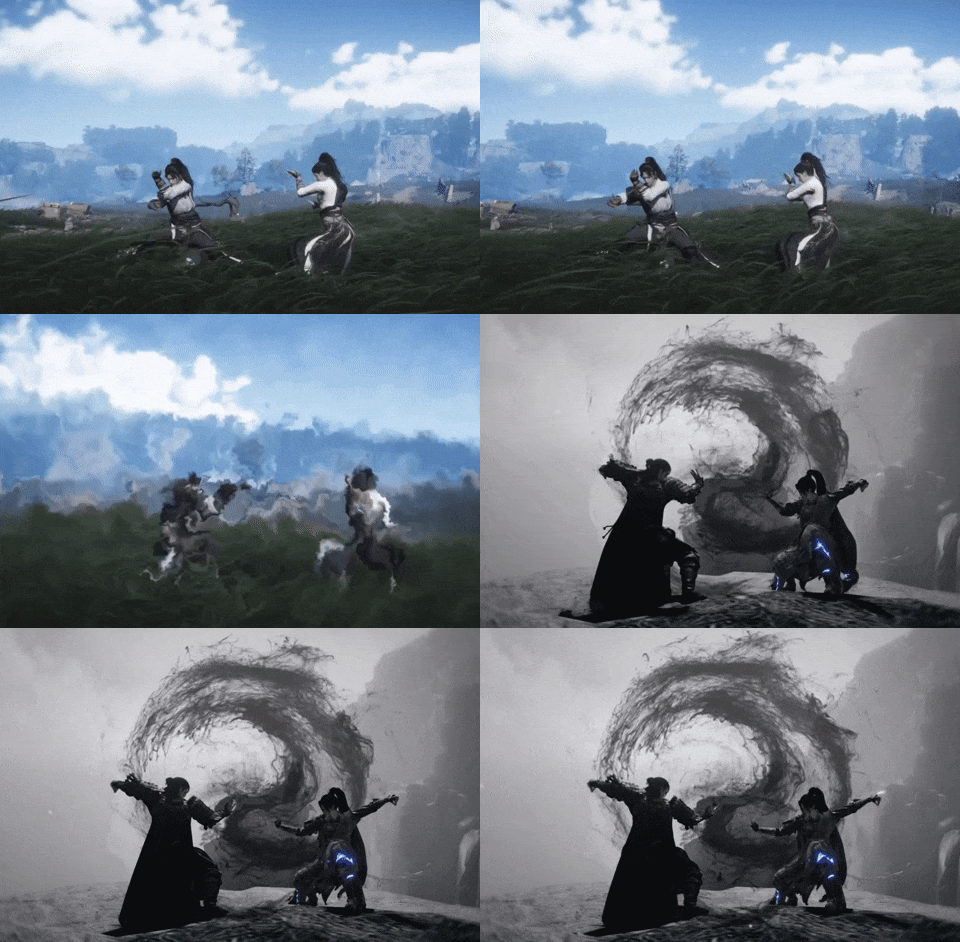
Where Winds Meet is the proof point the “frame has flipped” argument needs. NetEase’s wuxia open-world RPG launched globally in November 2025 after spending nearly a year in the Chinese market, where it had already attracted 40 million players before Western audiences ever touched it.
(Wuxia is China’s martial-heroes genre, the world of films like Crouching Tiger, Hidden Dragon.)
On its first day outside China it drew 2 million players. Within a month, 15 million. A record for any Chinese wuxia title reaching overseas markets. It holds 86% Very Positive across more than 61,000 English reviews. Its top market at launch was the United States at 17.8% of its Steam base, followed by Brazil, Germany, France.
Chinese players weren’t propping it up. It didn’t need them to. A game rooted entirely in Chinese martial arts culture, built on Chinese mythology, in a Chinese historical setting, walked into Western markets and topped their charts on its own merits.
That is not a market you are selling into. That is a market that is selling past you.
What This Means Monday Morning
The framework above is the product layer. Being seen in market activates it. A localized game nobody in China has heard of sells like an un-localized one.
Marketing presence on Bilibili, Weibo, and Douyin. 44.5% of Chinese gamers discover new games through short-form video on platforms like Douyin. Twitter and Instagram are Chinese-adjacent marketing, not Chinese marketing. Budgeting for one while skipping the other is how a good game stays unknown.
Weibo is China’s microblogging platform, the closest local analogue to X.
Real KOL relationships, not transactional ones. Chinese gaming communities can tell a paid post from a creator who actually played the game. One-off campaigns get burned. Creators who genuinely get your game move units.
Show up. Treat Chinese press the way you treat IGN and Eurogamer. Bring a localized demo to Next Fest with a community already paying attention.
None of this is secret. The Stellar Blade playbook is in the open. The Forza counter-example is in the open. The studios acting on it are not working from privileged information. They are just acting.
The Reframe
The market did not ignore you. You ignored it. And now you know what that cost.
Next in The Pattern Recognition: the genre wave most of Western gaming media has slept on. Why China’s microdrama industry now outgrosses its own box office, what Road to Empress’ $8.49 million-copy debut says about FMV’s return, and why a decade of gacha and pity-timer extraction has paradoxically made Chinese players the most premium-friendly audience on Steam.
Abbas Saleem is Principal Consultant at Llama & Griffin, a consultancy working with game studios across six continents. He writes The Pattern Recognition: gaming industry intelligence 12 to 24 months before it becomes consensus.
Find him on LinkedIn | Schedule a call on Calendly
The Chinese market is truly a diamond mine; even if their movies don't get a worldwide release, they can make them just for their own country and easily cross a billion dollars. It's huge.
If your game supports more than just your source language (which it should) - Chinese localization is mandatory.
Even for games that don't have partners in China to promote then and whose settings don't include Chinese elements - it's still worth it most of the time.