
China's Gacha Paradox
Why A Decade Of Extraction Made Chinese Players The Most Premium-Friendly Audience On Steam

TL;DR:
Gacha is a slot machine with better art direction. Premium currency buys a randomized shot at a rare character. A pity timer guarantees a hit after enough misses, which makes spending feel fair without making it smaller.
It worked at a scale nothing else has matched. Genshin Impact built a $10 billion franchise. Honor of Kings cleared $13 billion. Ten years of Chinese gaming pointed at extraction.
Then it exhausted the audience it was built on. Zenless Zone Zero’s iOS revenue is down roughly 88% from launch peak. Naavik calls the subgenre a zero-sum bloodbath, not an expanding market.
The contraction is structural, not cyclical. Tencent and NetEase are pivoting to lifestyle sims. Beijing’s 2023 draft rules on daily logins wiped roughly $80 billion off Chinese gaming market caps in a single day.
A decade of extraction did not create resistance to spending. It created hunger for the alternative. Black Myth: Wukong, 25 million at $60. Road to Empress, a million at $8.49. Stellar Blade, 56% of Steam sales from China at ¥268. A flat-price complete game lands with that audience as a gift.
The Puzzle Inside The Multiplier
Part 1 established the China Oppoturnity For a well-localized premium PC title on Steam, China is the largest single market. Stellar Blade pulled around 56% of its Steam sales from China. Split Fiction around 44%. It Takes Two close to half of its 23 million lifetime units.
Gacha scales with three variables:
Pricing posture
Localization depth
Content respect
Get those right and the data clusters tighter than anyone expects.
But it leaves a puzzle.
The audience driving those numbers is the same audience that spent the last decade on free-to-play mobile games engineered to extract money through randomized rewards. Genshin Impact built a $10 billion franchise on that architecture. Honor of Kings cleared $13 billion. The economic gravity of Chinese gaming has been pointed at extraction monetization for ten years.
So why is that same audience now the most enthusiastic premium PC audience on Steam? Why does a $60 single-player game with no microtransactions, no daily login, no banner notifications, hit 56% China share?
The answer is uncomfortable, and it is the rest of this piece.
The Architecture Of Extraction

This section is the uncomfortable part. Describing the architecture cleanly is how you understand the paradox that follows.
Two mechanics do all the work:
Gacha. Players spend premium currency for a randomized chance at a rare character or item. The name is the Japanese loan word for a toy capsule machine: coins in, contents unknown. Functionally a slot machine with better art direction.
Pity. A guaranteed high-rarity pull after a set number of failed attempts. Pity is the industry term for the floor beneath which a player cannot keep losing, built to prevent catastrophic disengagement. This is the casino’s near-miss mechanic formalized into a system. It does not reduce spending. It structures spending into a cycle that feels fair while extracting reliably.
What that architecture earned, and what it cost:
Genshin Impact: Built by the Shanghai studio miHoYo, it generated $6.4 billion on mobile alone in its first five years.
Honor of Kings: Tencent’s mobile competitive battle game has cleared $13 billion since 2015 on a version of the same architecture.
The reckoning: Genshin’s international operator, Cognosphere, was fined $20 million by the FTC over loot box odds, currency obfuscation, and marketing to children.
These systems are not poorly designed: They are exquisitely designed. They are also the most psychologically extractive consumer products that have ever shipped at scale, and they have been shipping to the same Chinese audience for ten years.
The Contraction Is Visible In The Data
The model is now hitting its ceiling. In public.
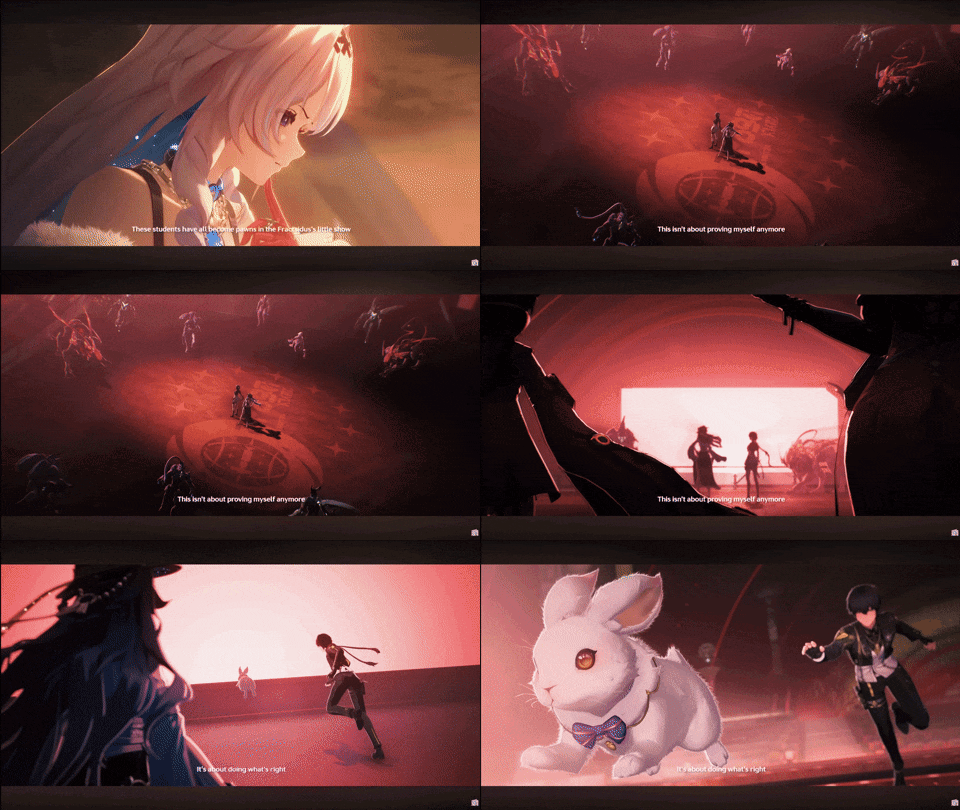
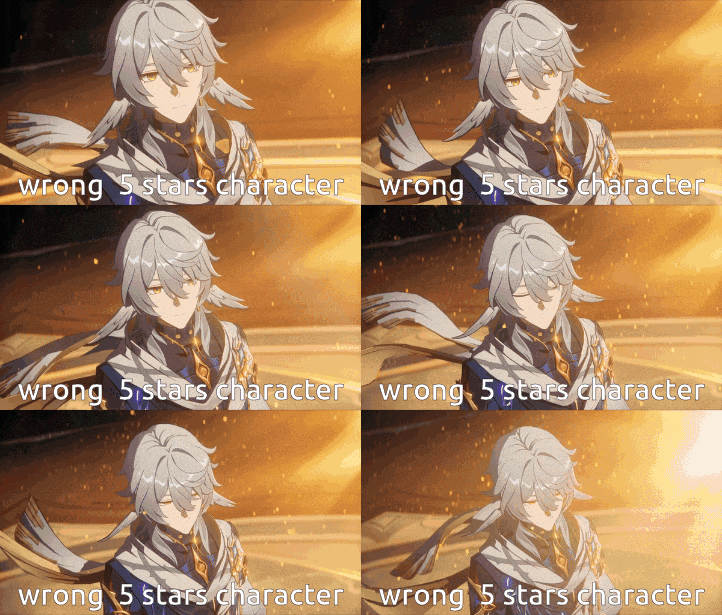
Zenless Zone Zero, miHoYo’s third major gacha title, saw its iOS revenue drop roughly 88% from its July 2024 launch peak, with major content updates showing diminishing returns.
Naavik reads the gacha-ARPG subgenre in 2025 not as an expanding total addressable market but as a zero-sum bloodbath. (ARPG is action role-playing game, real-time combat fused with character progression.)
The publishers are moving too. Tencent and NetEase, the two largest in the country, are visibly pivoting toward lifestyle simulation games. The studios that built the model are backing away from it.
The regulators got there first.
2021. Beijing caps under-18 playtime at one hour on weekdays and three on holidays.
December 2023. Regulators propose banning daily login rewards and consecutive-spending bonuses outright.
Within the day. Roughly $80 billion comes off Chinese gaming market caps.
Shortly after. Officials walk the proposals back.
The world’s most successful practitioners of casino-adjacent monetization have spent years in regulatory conflict with their own government over what they built. The government has been clearer about the problem than the industry has.
A decade of extraction. A burned audience. A monetization model whose practitioners and regulators are both pulling away from it.
That is the setup. Here is the paradox.
The Relief Is The Product
That same audience now responds to flat-price premium games with outsized enthusiasm. Not despite the decade of extraction. Because of it.
Three games, three price points, one shape.
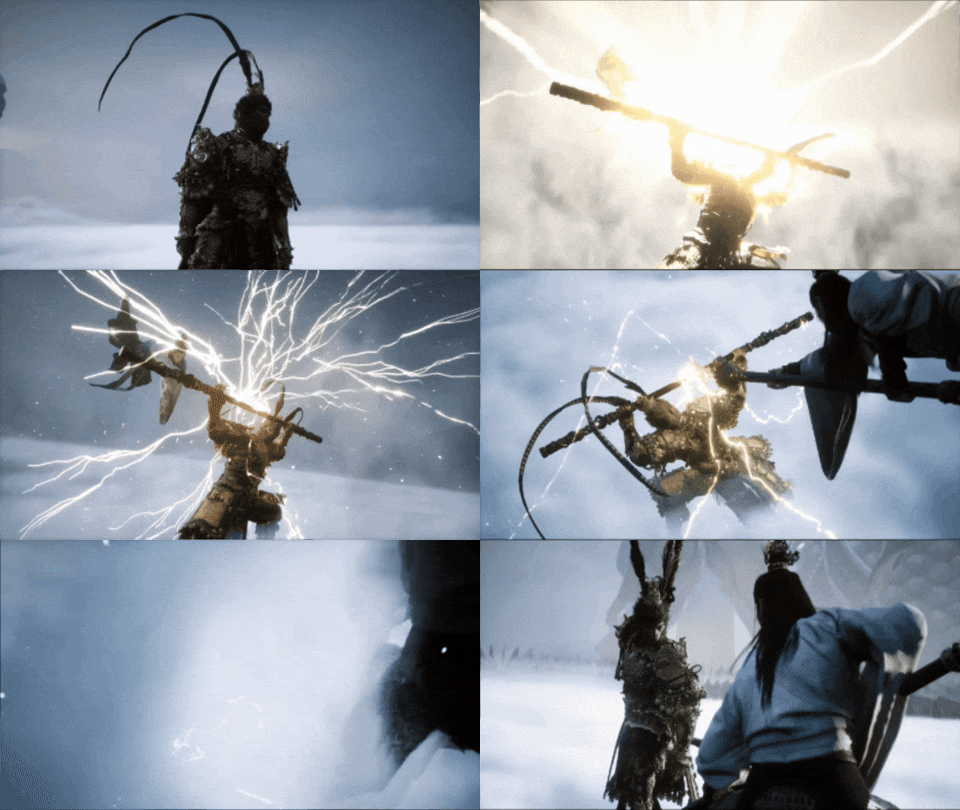
Black Myth: Wukong. 25 million copies at $60.
Road to Empress. A million copies at $8.49.
Stellar Blade. 56% of Steam sales from China at ¥268, premium-priced for the market.
No microtransactions. No daily login. No banner. No FOMO. One purchase, complete experience.
The pattern is not subtle. The trained audience does not want a different monetization model. It wants the model your $60 PC game has been using all along.
The relief is structural. The gacha-trained player has been conditioned to expect a banner notification, a daily reset, a stamina system, a probability gate. A premium PC game arrives with none of them. To that player it does not land as a baseline. It lands as a gift.
This is what most Western publishers have been reading wrong. The Chinese audience is not large because Chinese players spend more in absolute terms.
It is large for premium PC because that segment is where the relief is. The audience that handed Genshin its billions on mobile is the audience reaching for Black Myth, Stellar Blade, and Road to Empress on PC, and reaching with both hands.
What This Means For Your Pricing Decisions

The Multiplier framework from Part 1 told you what variables move the number. The gacha paradox tells you why the number moves at all.
The implication is uncomfortable for a category of studios that have been chasing the Chinese audience by trying to look like the Chinese audience’s existing diet.
If you are building a Western free-to-play game with daily logins, gacha-adjacent monetization, and battle-pass mechanics, and your strategy for the Chinese market is “more of what they already have,” you are building for the model the audience is actively leaving.
The studios picking up the audience right now are the ones doing the opposite.
For premium PC studios: stop apologizing for the price. The Chinese audience is the most premium-friendly audience on Steam not because they have more money than American players, but because so many studios have spent so long training them to want the alternative. Your $40-60 single-purchase game is the alternative. Lead with it.
For studios still building extraction-heavy free-to-play: the audience the gacha model spent a decade training is now actively leaving the gacha model. Tencent and NetEase are pivoting. miHoYo’s third game is contracting. The Chinese government is two steps ahead of you on regulation. Read the room.
For studios in the middle: the design principles that make a premium PC game land with this audience (clean transaction, complete content, fair price, sharpened cultural specificity) are also the principles that protect you from being on the wrong side of the next regulatory cycle. Building for the relief is also building for what comes next.
The Reframe

A decade of extraction did not create resistance to spending. It created hunger for the alternative.
The Chinese audience is not premium-friendly despite the gacha decade. It is premium-friendly because of it. The Multiplier from Part 1 lands at the numbers it lands at because Black Myth and Stellar Blade and Road to Empress are exactly what an exhausted audience reaches for.
The studios delivering on that exhaustion are picking up share now. The studios still building for the model the audience is leaving are not.
Next in The Pattern Recognition: the GCC studios quietly outshipping their European counterparts, and what Saudi Arabia’s $38 billion gaming bet means for the production base that supplies the global mid-tier in 2027. Plus: why the Gulf is where Korean and Chinese studios are now opening their first non-Asian offices.
Abbas Saleem is Principal Consultant at Llama & Griffin, a consultancy working with game studios across six continents. He writes The Pattern Recognition: gaming industry intelligence 12 to 24 months before it becomes consensus.
Find him on LinkedIn | Schedule a call on Calendly